
Saguaro is a spectacular columnar cactus that can make a real statement in desert gardens. However, a saguaro can be a major investment, and they are not ideal for every situation. Here’s everything you need to know about growing this Sonoran Desert native as a landscape plant.

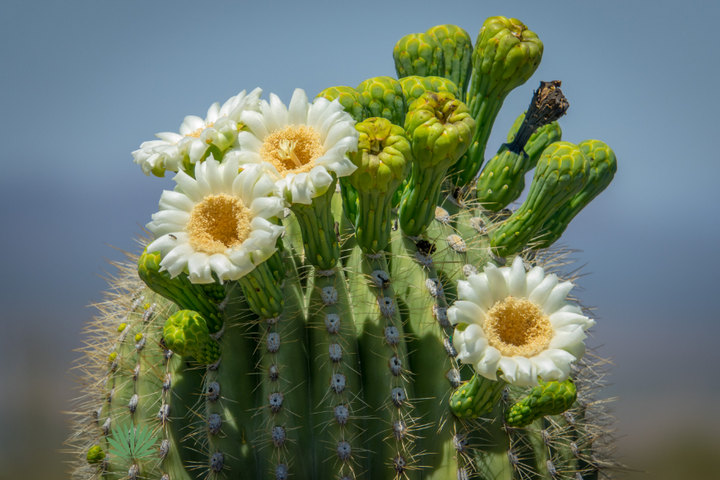
Saguaro (Carnegiea gigantea) just might be the most famous cactus in the world. It’s often used as a universal symbol for cactus 🌵and of the American West, even though it has a limited native range.
Young plants grow as a single column called a “spear”. As plants mature, most will put out 1 to 5 arms sometime between 35 and 90 years of age. But some specimens have as many as 50 arms!
Saguaro makes a particularly dramatic and undemanding landscape plant. The only care you need to provide is to water occasionally, especially the first few years, and clean up any fallen fruit.
Saguaro is a keystone species that supports a wide variety of wildlife.
In May, saguaro flowers open after nightfall and close by late afternoon the following day, attracting pollinators around the clock. During the day, they attract bees and birds including hummingbirds, doves, and woodpeckers. At night, they are pollinated by bats.
Flowers are followed by green fruits that burst open when ripe. The red pulp is enjoyed by birds, bats, desert tortoises, javelinas, coyotes, and small mammals. (And if the critters leave you any fruit, you can use it to make jam, syrup, juice, or wine.)
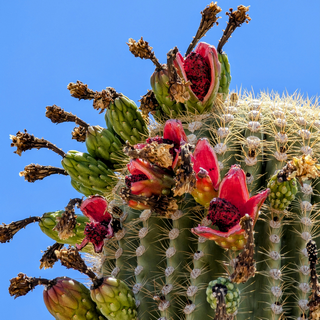
The small black seeds provide food for small mammals and birds, especially white-winged doves.
Saguaros provide shelter for nesting birds. Gila woodpeckers and gilded flickers dig out holes to nest in. Other species including elf owls, cactus wrens, and finches move into abandoned nests. Tall saguaros make good hunting and resting perches for birds, as well.
Why I Like This Plant
- Spectacular icon of the desert southwest
- Makes a stunning focal point
- Beautiful white flowers, red fruits
- Nearly maintenance-free
- Tremendous for supporting wildlife
Things to Watch Out For
Saguaros are a beloved icon. Who wouldn’t want one in their yard? But there are some concerns with growing saguaros, especially in small urban or suburban yards.
Too Much Water
A saguaro should be planted among other desert-adapted plants that are minimally irrigated (or not irrigated at all).
Saguaro roots grow wide, not deep. They typically grow 2 feet deep but extend twice as far as the cactus is tall, and can extend up to 100 feet! So even if you don’t water your saguaro, it can get too much water from being planted near plants that are on irrigation.
We’ve all seen plump, over-watered saguaros that have sucked up too much water.
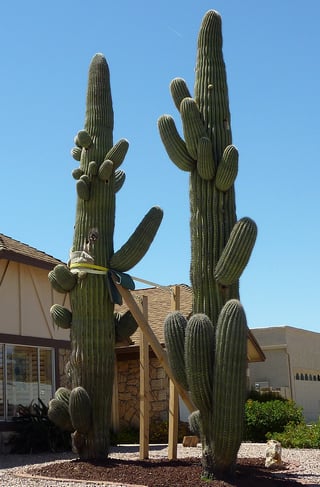
Unfortunately, fatties like this are prone to losing arms or falling over. They’re also susceptible to diseases, including root rot and bacterial necrosis, the major cause of saguaro death.
Mature Size
Before planting one, keep its ultimate size in mind. Not only do saguaros grow tall, once they develop arms, they take up a lot of horizontal space, which can infringe on sidewalks, driveways, or houses. Their massive size makes them impractical for many small yards.
Don’t plant one too close to your house, garage, pool, or garden wall. If they fall or lose an arm, they can cause massive damage since they can weigh up to 9 tons.
Optimal Growing Conditions
If you’re thinking of adding a saguaro to your garden, you need to find a suitable place that will keep your plant healthy and looking good… while minimizing maintenance for you.
Here are the key factors to keep in mind.
Temperature
Saguaros should be grown in USDA Hardiness Zones 9 to 11. As you would expect from a desert native, it can handle normal summer heat.
However, saguaros have been struggling in heat islands like Phoenix the past few years, especially when high nighttime temperatures cause additional stress.
Minimum cold temperatures are this species’ limiting factor and determine its range. Saguaros can survive short dips down to the mid-teens, but severe damage can occur when the temperature stays below 20°F for periods of 15 to 20 hours.
Sun Exposure
Saguaro’s sun tolerance changes through time. Young saguaros benefit greatly from protective shade and are usually found growing under the canopy of a nurse tree. As they mature, they can take full or even reflected sun off a hot garden wall or building.
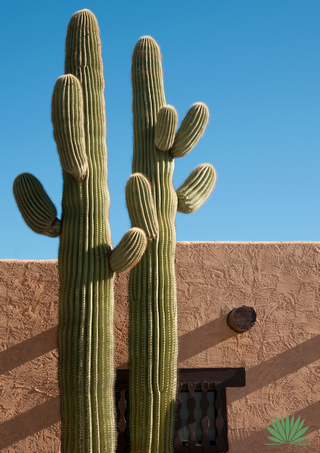
It’s recommended that you protect a newly planted saguaro with temporary shade such as wrapping it in 30% shade cloth for the first year.
Size and Growth Rate
Saguaro is a very slow growing cactus. It can take up to 10 years for a seedling to reach a size of 3 inches. 😮
A mature saguaro can reach a size of 40 feet tall with a trunk diameter of 30 inches. But the amount of horizontal space it will take up depends on how many arms it develops. There is no way to predict this.
Soil
In its native habitat, saguaros grow on rocky or gravelly slopes, canyons, and foothills, or along sandy washes.
In the landscape, it will grow well-draining sandy or rocky soil. They do not do well in heavy clay.
Other Location Considerations
Saguaros should not be planted near foot traffic or anywhere people or pets might bump into their thorns.
Since they drop red fruit in the spring, don’t plant next to a pool, patio, driveway, or anywhere you don’t want a red sticky mess.
Saguaro:
The Essentials
| Common Name | Saguaro |
| Scientific Name | Carnegiea gigantea |
| Origin | Sonoran Desert |
| Plant Type | Columnar cactus |
| USDA Zones | Zones 8 – 11 |
| Cold Hardiness | To 15℉ |
| Flower Color | White |
| Flower Season | Spring |
| Mature Size | 40′ tall, 30″ wide |
| Growth Rate | Very slow |
| Sun Tolerance | Full, part, reflected sun |
| Water Needs | Very low |
| Pests & Diseases | Bacterial necrosis |
| Cautions | Spines |
| Wildlife | Supports wildlife of all kinds |
Planting Saguaro Cactus
Planting a saguaro is not like adding any other plant to your garden. Before obtaining a saguaro, you have an important decision to make…
What size saguaro do you want?
Why Size Matters (& small is better)
The size of the plant you obtain matters for several important reasons.
Smaller saguaros, in the 1 to 2 foot range, are ideal for planting in the landscape. You can transport and plant one of this size by yourself.
Plants that are 3 to 4 feet tall are reaching the limits of what the average gardener can handle, since they can weigh up to 100 pounds per linear foot.
Studies of saguaro transplants have found that survival is inversely related to size. The smaller the plant, the better the survival rate. Plants under two feet tall nearly always survive, while plants over 25 feet tall rarely survive.
Saguaros are expensive and usually run $100 to $150 per linear foot.
If price is not a concern and you want to buy one 5′ or larger, you’ll need to have it transported and have a team of cactus professionals plant it. They are heavy, expensive, and if not done right, have a high failure rate.
The Tucson Cactus & Succulent Society rescues saguaros,
and occasionally offers them for sale to the public.
Check their events calendar for upcoming sales.
Tips for Planting Success
Planting a saguaro can be tricky. Here are recommendations for increased success.
- Plant it in the same direction that it was previously growing.
- Plant it no deeper than it was previously growing.
- Refill the planting hole with native backfill only (no amendments).
- Do not water after planting for several weeks.
- Keep the spear wrapped with shade cloth for the first year.
- The best time to plant is in the spring when warm soil temperatures encourage root development.
Before planting a saguaro, I highly recommend reading the University of Arizona publication Selecting and Planting Saguaro, which goes into great detail on the best practices for planting saguaros.
If you live outside of southern Arizona, check out Habitats For Wild and Cultivated Saguaro, which gives a state-by-state rundown on where you can and can’t grow saguaros. Saguaros are fussy when it comes to growing outside their native range.
Rules & Regs
Saguaros are a protected species. It’s illegal to harm them or dig them up. A permit is required to move or destroy them for building or other purposes. You can find all the rules and regulations regarding saguaros at the Arizona Department of Agriculture.
How to Care for Saguaro
Whether you’ve recently planted a saguaro or have an existing plant in your yard, here’s how to take care of it to keep it healthy and looking its best.
How to Water New Plants
A newly planted saguaro should not be watered for 2 to 4 weeks if planted during warm weather. If planted in the winter, it should not be watered for at least a month.
Then, water every 3 weeks from spring through fall. No watering should be needed during the winter, provided you’ve had normal seasonal rains.
When you water, the rule of thumb is to give your new saguaro one gallon of water per linear foot. This should be done for 4 years.
Once it’s established, it should not need any water, unless you’re experiencing severe drought.
Recommended Reading:
7 Tips for Watering Landscape Cactus (& Other Succulents)
Pests & Diseases
The most devastating disease to be concerned with is bacterial necrosis. The symptoms are oozing brown or black liquid surrounded by mushy tissue.
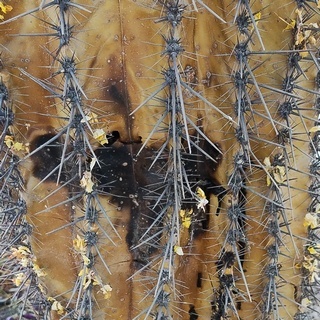
You can learn more about identifying and treating it in the University of Arizona publication Saguaro Problems, Pest and Disease.
Plant Lover Facts
Saguaro (Carnegiea gigantea) is the only member of the Carnegiea genus. It was named after industrialist Andrew Carnegie, whose Carnegie Institution established the Desert Botanical Laboratory in Tucson, which is now known as the Desert Laboratory on Tumamoc Hill.
Saguaros are native to southern Arizona, northwestern Mexico, and a tiny pocket of California.
Saguaro flowers are the Arizona State flower.
Saguaros are so important to the Tohono O’odham Nation that they passed a resolution granting saguaros personhood.
Saguaros are 85% water and can hold up to 200 gallons of water in their tissues.
Native Americans put various parts of the saguaro to good use. They used the woody ribs to make tools and as a building material. The fruits were used to make dried fruit, syrup, beverages, and preserves. The seeds were ground into flour or used as a source of oil.
Did you enjoy this article?
Sign up for our weekly newsletter
where you’ll find more great info on creating &
maintaining a beautiful, carefree desert landscape.
Author Bio
Deane Alban is the creator of Southwest Gardener. She is a science writer with a bachelor’s degree in botany from the University of South Florida. Gardening is her lifelong passion. She’s been gardening in Tucson for over 16 years.
