
Rocky Point ice plant is a succulent, evergreen ground cover. When in bloom, it’s dotted with shimmery, daisy-like flowers. Here’s everything you need to know about growing this delightful South African native in this complete care guide.
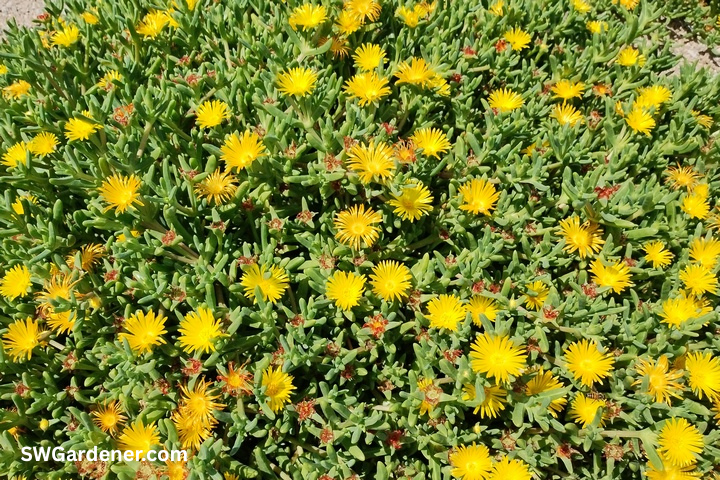
Rocky Point ice plant (Malephora lutea) is a heat-loving ground cover with small, green succulent leaves and starbursts of yellow flowers that bloom intermittently throughout the year.
If you look closely, the flowers and the leaves appear to glisten. Like all ice plants, Rocky Point has small transparent bladders that reflect and refract light, making them sparkle.
This dainty-looking plant is tougher than it looks. It tolerates desert temperature extremes and needs relatively little water. In its native habitat of South Africa, it survives on about 20″ of rain per year.
Once established, it forms a dense mat that keeps weeds at bay.
Why I Like This Plant
- Evergreen succulent foliage
- Cheerful yellow flowers
- Looks pretty all year
- Forms a weed-smothering mat
- Supports bees, birds
Things to Watch Out For
Rocky Point ice plant is easily crushed or broken and does not stand up to foot traffic.
It attracts birds, but perhaps not in the way you want. Thirsty birds have been known to peck at the succulent leaves for moisture. If this happens, you can lure them away with a bird bath or other water source.
Optimal Growing Conditions
If you’re thinking of adding Rocky Point ice plant to your garden, you need to find a suitable place that will keep your plant healthy and looking good… while minimizing maintenance for you.
Here are the key factors to keep in mind.
Temperature
Rocky Point ice plant should be grown in USDA Hardiness Zones 8 – 11. It’s tolerant of desert heat and cold down to 15℉.
Occasionally, some leaves may turn brown from extreme heat. This damage is cosmetic and can be pruned off in the fall.
Sun Exposure
Rocky Point ice plant can be grown in full sun or part shade. In the low desert, it will be happier with some relief from full sun.
Size and Growth Rate
Rocky Point ice plant is a fast-growing ground cover. It stays under 1 foot tall and usually spreads 3 to 4 feet wide. But in the right spot, it can spread up to 6 feet across.
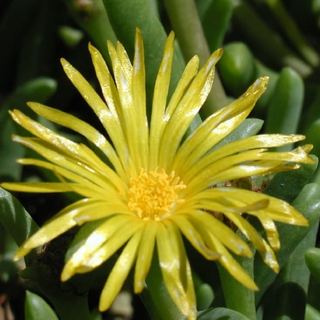
It blooms intermittently throughout the year, occasionally taking short breaks. As you can see in this close-up, these adorable, 1 inch flowers shimmer in the sunlight.
Soil
Rocky Point ice plant prefers sandy or rocky soil, but will grow in any desert soil, provided it’s well-draining.
Other Location Considerations
Since it is virtually litter-free and non-toxic, this ground cover is a good choice to grow along pools, patios, walkways, or anywhere else it may come in contact with people or pets, provided it won’t get stepped on.
Rocky Point ice plant makes a beautiful “spiller” in large patio planters, raised beds, or hanging baskets. It can be planted on slopes for erosion control or allowed to cascade over raised beds or walls.
If you grow one in a pot, be sure it has good drainage and use specifically formulated cactus soil.
Rocky Point Ice Plant:
The Essentials
| Common Name | Rocky Point ice plant |
| Scientific Name | Malephora lutea |
| Origin | South Africa |
| Plant Type | Evergreen ground cover |
| USDA Zones | Zones 8 – 11 |
| Cold Hardiness | To 15℉ |
| Flower Color | Yellow |
| Flower Season | All year (intermittent) |
| Mature Size | 8″ high x 3-4’ wide |
| Growth Rate | Fast |
| Sun Tolerance | Full, part shade |
| Water Needs | Low |
| Pests & Diseases | Root rot if overwatered |
| Garden Friendly | Low litter, non-toxic |
| Wildlife | Supports bees |
How to Plant
The rule of thumb when planting any ground cover in the desert is to dig a hole twice as wide as the root ball but no deeper.
Since Rocky Point ice plant prefers sandy or rocky soil, consider amending with coarse sand or small gravel, especially if your soil doesn’t have good drainage.
When to Plant
The best time to plant Rocky Point ice plant is in the fall. This gives it three seasons to grow roots and get established before the following summer.
The second best time is in spring, the earlier the better. This still gives your plant time to get established before the intense heat of June arrives.
How to Care for Rocky Point Ice Plant
Whether you’ve recently planted a Rocky Point ice plant or have existing plants in your yard, here’s how to take care of them to keep them healthy and looking their best.
How to Water
The University of Arizona recommends watering newly planted, low water use ground covers on this schedule.
| Weeks 1 – 4 | Every 2 – 3 days |
| Weeks 5 & 6 | Every 6 – 7 days |
| Weeks 7 & 8 | Every 10 – 14 days |
Give your ice plant about ½ gallon with each watering.
After that, you can water it on this schedule:
| Spring (March – May) | 10 – 14 days |
| Summer (May – Oct.) | 7 – 10 days |
| Fall (Oct. – Dec.) | 10 – 14 days |
| Winter (Dec – March) | 14 – 21 days |
As it grows, it will need more water with each watering, depending on its diameter. Use this chart as a guide.
| 1′ diameter | .5 gallons |
| 2′ diameter | 2 gallons |
| 3′ diameter | 3.5 gallons |
| 4′ diameter | 5 gallons |
If you’re growing one in a container, use this watering schedule as a guide.
| Spring & Fall | Every 7-10 days |
| Summer | Every 5-7 days |
| Winter | Every 10-14 days |
Should You Fertilize?
Rocky Point ice plant does not need to be fertilized. It evolved to grow in poor, rocky soil.
Pruning & Propagation
Rocky Point ice plant is an easily managed ground cover that can be trimmed anytime it overgrows its spot.
You can use any healthy cuttings to propagate new plants. This works best in the spring.
Prune any stems that show signs of cold damage in the spring or heat damage in the fall.
Plant Lover Facts
Rocky Point ice plant (Malephora lutea) also goes by the common names yellow ice plant or yellow trailing ice plant.
When I first learned of this plant, I assumed it was a Mexican native that was named after Rocky Point, aka Puerto Peñasco, Mexico. (Rocky Point is a popular beach town not far from the Arizona border.) So I was surprised to learn that it’s native to South Africa.
Yet many sources claim it’s named after the Mexican beach town. I found this puzzling. 🤔
The story goes that a specimen was found growing in Rocky Point, Mexico, and that’s how it got its name. However, this seems highly unlikely since there are dozens of places called Rocky Point throughout the world, including in its home continent of Africa.
Did you enjoy this article?
Sign up for our weekly newsletter
where you’ll find more great info on creating &
maintaining a beautiful, carefree desert landscape.
Author Bio
Deane Alban is the creator of Southwest Gardener. She is a science writer with a bachelor’s degree in botany from the University of South Florida. Gardening is her lifelong passion. She’s been gardening in Tucson for over 15 years.
