
If you’re looking for something a little different from the more commonly grown penstemons, consider rock penstemon. This lovely wildflower is unusual in a number of ways. Here’s everything you need to know about growing this Chihuahuan Desert native.
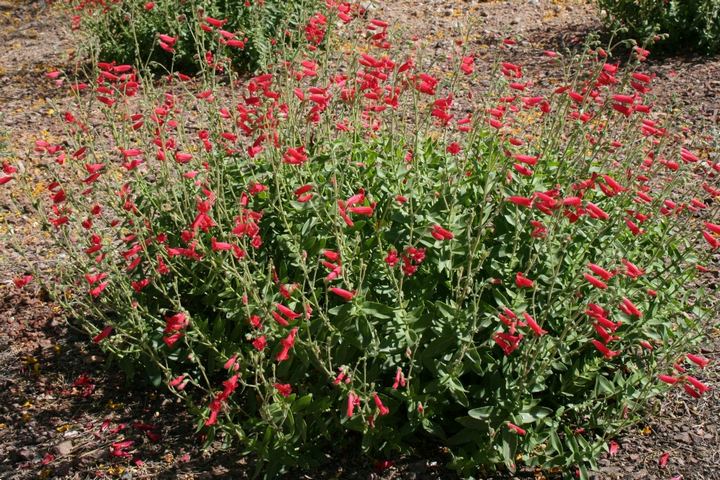
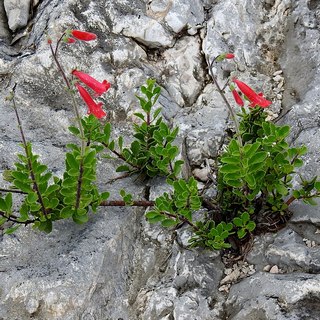
Rock penstemon (Penstemon baccharifolius) is a wildflower that lives up to its name. It naturally grows on rocky, limestone cliffs and can grow straight out of rock!
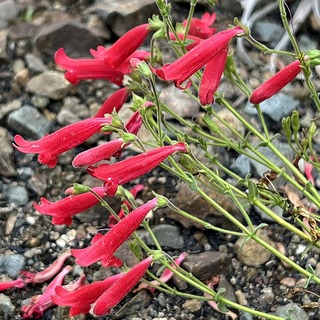
This small shrubby perennial has small, deep green leaves and pinkish-red, tubular flowers. Of all the southwest penstemons, it has one of the longest bloom periods — from spring through fall and sometimes through the winter, if it’s been mild.
Unlike many penstemons that go dormant, rock penstemon typically stays evergreen. It grows either erect as a small shrub or more sprawling to form a ground cover.
The flowers attract butterflies and hummingbirds. Plants are larval hosts for several species of moths and butterflies. Deer and rabbits usually leave this plant alone.
Why I Like This Plant
- Evergreen foliage
- Red flowers spring through fall
- Low-maintenance native
- Low litter, no thorns
- Supports pollinators
Things to Watch Out For
Rock penstemon isn’t widely available, but you may find it at nurseries that specialize in native plants. I’ve seen plants for sale at Spadefoot Nursery, one of Tucson’s premier native plant nurseries.
Unlike some other southwest penstemon species, rock penstemon is not easy to grow from seed. Plants started from seed are slow to establish. The tiny seeds are hard to collect and should be cold-stratified before planting. This is very different from Parry’s penstemon, which readily reseeds.
Rock penstemon is a short-lived perennial, living only 3 to 6 years, and it may or may not reseed in your garden.
Penstemons are not considered poisonous, but since they can accumulate selenium, it’s best to keep people, pets, poultry, and livestock from consuming any species of penstemon.
Optimal Growing Conditions
If you’re thinking of adding rock penstemon to your garden, you need to find a suitable place that will keep your plant looking good and coming back every year.
Here are the main factors to keep in mind.
Temperature
Rock penstemon should be grown in USDA Hardiness Zones 8 – 10. It may lose leaves when the temperature dips into the twenties, but it will survive down to 10°F.
Sun Exposure
Rock penstemon can be grown in part or full sun, but it appreciates relief from afternoon sun. It’s especially helpful to keep the roots shaded from intense sun.
Size and Growth Rate
Rock penstemon grows moderately fast, reaching a size of 1 to 2 feet tall by 2 feet wide.
Soil
In its native habitat, rock penstemon grows in sandy or rocky soil, but it will grow in any type of desert soil, provided it’s well-draining. Here’s a picture of it growing on a rocky cliff.
Avoid planting in clay or any poor-draining soil unless you can sufficiently amend your soil with sand or gravel to provide excellent drainage.
Rock Penstemon:
The Essentials
| Common Name | Rock penstemon |
| Scientific Name | Penstemon baccharifolius |
| Origin | Texas, Mexico |
| Plant Type | Perennial wildflower |
| USDA Zones | Zones 8 – 10 |
| Cold Hardiness | To 10℉ |
| Flower Color | Red |
| Flower Season | Spring, summer, fall |
| Mature Size | 1-2’ high x 2’ wide |
| Growth Rate | Moderate to fast |
| Sun Tolerance | Full, part sun |
| Water Needs | Low |
| Pests & Diseases | Root rot |
| Garden Friendly | No thorns, non-toxic, low litter |
| Wildlife | Attracts hummingbirds, butterflies, moths |
How to Plant
The rule of thumb when planting any perennial in the desert is to dig a hole twice as wide as the root ball but no deeper.
If you have sandy or rocky soil, amending the soil is not recommended. Counterintuitively, backfilling with the same native soil you just dug up helps your penstemon develop a stronger root system.
However, if your soil is not well-draining or clay, amend it with enough sand or small gravel to improve drainage.
When to Plant
The best time to plant rock penstemon is in the fall. This gives it three seasons to grow roots and get established before the following summer.
The second best time is in spring, the earlier the better. This still gives it time to get established before the intense heat of June arrives.
How to Care for Rock Penstemon
This section is short because these plants need little care.
How to Water
While your plant could live on rainfall alone — as it does in the wild — it will perform better if it gets watered 1 to 2 times per month, either from rainfall or irrigation.
Should You Fertilize?
Native wildflowers like rock penstemon don’t need fertilizer since they are well-adapted to thrive in native soil.
Don’t topdress with organic mulch or compost. Remember the word “rock” in its name! These plants do better when surrounded by gravel.
Pruning
Rock penstemon needs no pruning other than cutting the spent flower stalks. Deadheading flowers can promote more blossoms.
If your plant experiences cold damage, remove any damaged leaves in late winter to encourage new growth.
Rock Penstemon: An Alternative to Autumn Sage
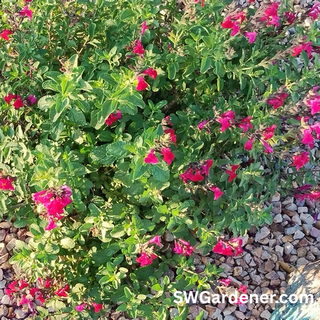
Rock penstemon’s small, mounding form and cherry red flowers make it a good alternative for autumn sage (Salvia greggii). Unfortunately, this lovely, popular landscape plant has become borderline heat tolerant, and many gardening experts now caution against growing it in the desert. It rarely survives in Phoenix and currently struggles in Tucson. I’ve lost a few, and no longer see it growing in my neighborhood.
Plant Lover Facts
Rock penstemon goes by several other “mix and match” common names, including rock beardtongue, cut leaf penstemon, cut leaf beardtongue, baccharis leaf penstemon, and baccharis-leaf beardtongue.
It’s native to southern Texas and eastern Mexico.
Did you enjoy this article?
Sign up for our weekly newsletter
where you’ll find more great info on creating &
maintaining a beautiful, carefree desert landscape.
Author Bio
Deane Alban is the creator of Southwest Gardener. She is a science writer with a bachelor’s degree in botany from the University of South Florida. Gardening is her lifelong passion. She’s been gardening in Tucson for over 15 years.
