
Quadricolor century plant is a stunning, multicolor agave that stands out in desert gardens. It stays compact but produces an endless supply of offsets. Here’s everything you need to know about planting and taking care of this Chihuahuan Desert native.
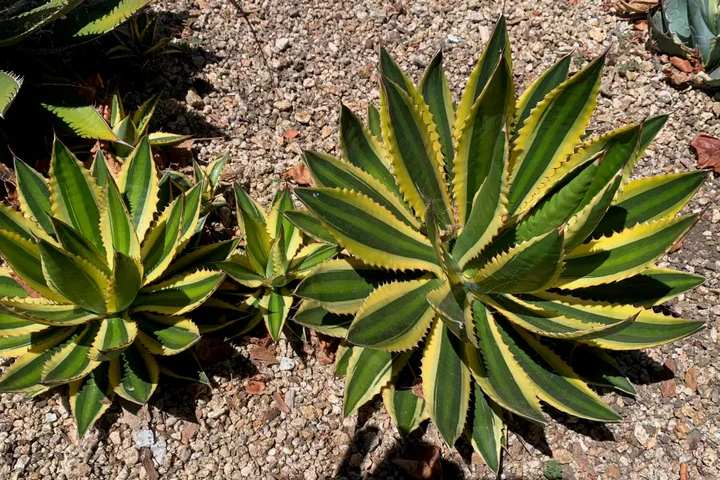
Quadricolor century plant (Agave lophantha ‘Quadricolor’) is a small, stunning agave cultivar that is particularly colorful and really pops in desert gardens.
Its three-tone leaves are striped with creamy yellow, pale green, and dark green. The leaf margins are lined with teeth that can be red-brown or gray.
It is an extremely low-maintenance plant. It can take either full or part sun, grows slowly, doesn’t need pruning, needs minimal water, and doesn’t produce litter.
But it produces a prodigious number of offsets or “pups”. If you’re looking for an agave to naturalize in your yard to fill in bare spaces, this plant is up for the task.
Why I Like This Plant
- Looks beautiful all year
- Eye-catching striped leaves
- Extremely hardy, low-maintenance
- Produces many offsets (maybe too many?)
Things to Watch Out For
Everything about quadricolor century plant says “Do not touch”. Its leaves are lined with sharp teeth and have wicked spines at the tips.
It prolifically produces offsets, and you may find yourself frequently removing and transplanting them, which is a tricky task with this spiky plant. It’s strongly advised that you “armor up” before working with it. I wear long sleeves, my toughest gloves, and eye protection when handling it.
Additionally, agaves contain compounds that can cause a rash called agave dermatitis in some people.
Optimal Growing Conditions
If you’re thinking of adding a quadricolor century plant to your garden, you need to find a suitable place that will keep your plant healthy and looking good… while minimizing maintenance for you.
Here are the key factors to keep in mind.
Temperature
Quadricolor century plant should be grown in USDA Hardiness Zones 9 to 11. As a Chihuahuan Desert native, it can take extreme heat and cold, surviving temperatures down to 15℉.
Sun Exposure
You can plant quadricolor century plant in full sun or part shade. It performs best where it gets some relief from intense afternoon sun.
Size and Growth Rate
Quadricolor century plant is slow growing and ultimately reaches a mature size of only 1 to 2 feet tall and 2 to 3 feet wide. However, it forms small colonies that will continue to spread unless you remove pups to control the cluster size.
It can live to be anywhere from 8 to 20 years old. At the end of its lifecycle, it will send up a 10 to 12 foot flower stalk and then die. If you’ve left some pups, these new plants will take the place of the original.
Soil
Quadricolor century plant prefers rocky, alkaline desert soil. Planting in poor soil will help avoid root rot.
It can be grown in pots but needs excellent drainage. Make sure your pot has adequate drainage holes and use specifically formulated cactus soil.
Other Location Considerations
Due to this plant’s extreme spiky nature, keep it away from people and pets. Do not put it near a sidewalk, pool, front door, or anywhere people might brush against it.
Quadricolor Century Plant:
The Essentials
| Common Name | Quadricolor century plant |
| Scientific Name | Agave lophantha ‘Quadricolor’ |
| Origin | Texas, Mexico |
| USDA Zones | Zones 9 – 11 |
| Cold Hardiness | To 15℉ |
| Mature Size | 1-2′ tall x 2-3’ wide |
| Growth Rate | Slow |
| Sun Tolerance | Full, part sun |
| Water Needs | Low |
| Pests & Diseases | Root rot if overwatered |
| Cautions | Agave dermatitis, spines |
| Wildlife | Deer resistant |
How to Plant
To plant an agave, dig a hole the same depth as the root system and twice as wide. Carefully remove the plant from the container, put it in the hole, and fill with the same native soil you just removed. Press the soil to remove any air pockets.
Never plant deeper than the depth of the root ball which can cause rot. Actually, it’s best to plant an inch or two above soil level to give the plant room to settle and leave room for mulch.
It’s generally recommended that you not add amendments to the soil. However, good drainage is critical, so if your soil drains slowly, amend with coarse sand or small gravel until you have a loose, well-drained mix.
When to Plant
The best time to plant agaves is in April or May. The warm temperatures of spring encourage root development.
How to Care for Quadricolor Century Plant
Whether you’ve recently planted a quadricolor century plant or have an existing plant in your yard, here’s how to take care of it to keep it healthy and looking its best.
How to Water
You’re probably used to giving a plant a good soaking immediately after transplanting, but that isn’t the best practice with agaves.
Counterintuitively, it’s best to not water agaves for one to two weeks after planting. Then use the following schedule as a guide.
| Spring & Fall | Every 3-5 weeks |
| Summer | Every 2-4 weeks |
| Winter | Only if no winter rains |
Plants can survive on rainfall alone once established, but will look their best with some irrigation.
Frequent watering will make an agave grow larger, faster. This might sound like a good thing, but it causes the plant to reach the end of its life span sooner.
If you’re growing your agave in a container, use this watering schedule as a guide.
| Spring & Fall | Every 7-10 days |
| Summer | Every 5-7 days |
| Winter | Every 10-14 days |
Should You Fertilize?
There is no need to fertilize quadricolor century plant, it gets all the nutrients it needs from the surrounding desert soil. But if you grow one in a pot, fertilize it lightly once a month spring through summer.
Pruning & Propagation
Quadricolor century plant should not be pruned except to remove dead or damaged lower leaves. However, you may want to remove unwanted offsets, which you can use to start new plants.
Quadricolor century plant is easy to propagate. All you have to do is dig up the pups, making sure that some root remains intact, and plant them in pots or elsewhere in your yard.
Pests
Agave snout weevil is an insect that can attack and kill any agave, but fortunately, smaller agaves like quadricolor century plant are less susceptible than many other species.
Plant Lover Facts
Quadricolor century plant (Agave lophantha ‘Quadricolor’) is a cultivar of the species Agave lophantha, a slightly larger, solid green agave that goes by the common names thorncrest century plant and thorn-crested agave.
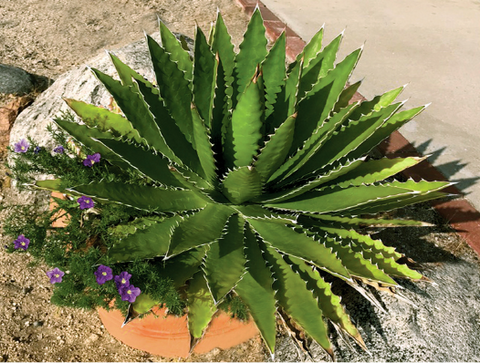
The parent plant is native to southwest Texas and northern Mexico.
You may wonder where the name quadricolor came from since there are only three obvious colors — yellow plus two shades of green. The fourth color purportedly refers to its row of colorful teeth.
Did you enjoy this article?
Sign up for our weekly newsletter
where you’ll find more great info on creating &
maintaining a beautiful, carefree desert landscape.
Author Bio
Deane Alban is the creator of Southwest Gardener. She is a science writer with a bachelor’s degree in botany from the University of South Florida. Gardening is her lifelong passion. She’s been gardening in Tucson for over 15 years.
