
When in bloom, pink jasmine smells heavenly and is one of the most delicately beautiful vines you’ll see growing in the desert. It’s not hard to grow, provided you plant it in the right spot. Here’s how to grow and care for this lovely Asian native in the hot, dry southwest.
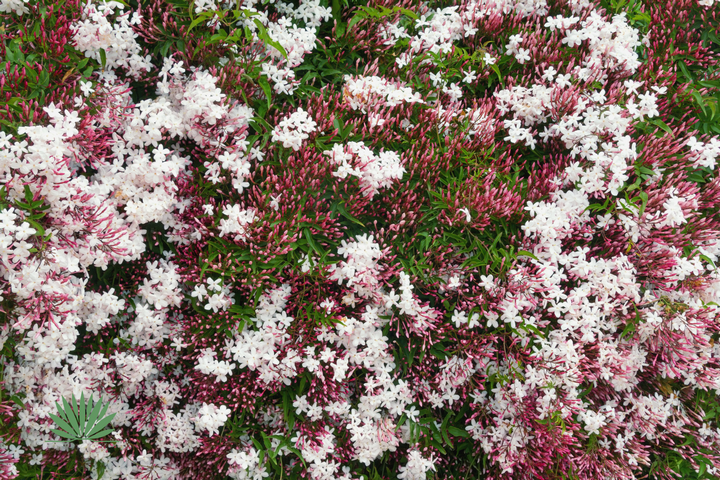
Pink jasmine (Jasminum polyanthum) is an evergreen vine with leaves that are dark green on top with lighter green undersides. In late winter to early spring, it explodes with clusters of rose pink buds followed by a cloud of white flowers shaped like dainty stars. When in bloom, it’s breathtakingly beautiful.
Pink jasmine looks delicate, and it isn’t as suited to harsh desert conditions as native vines. But it isn’t hard to grow, provided you take into account its preferences. Many gardeners fall in love with its gorgeous, fragrant flowers and feel a little extra planning and care is worth it.
Why I Like This Plant
- Rosy pink buds and fragrant white flowers
- Evergreen foliage
- No thorns, not toxic
- Attract butterflies
Things to Watch Out For
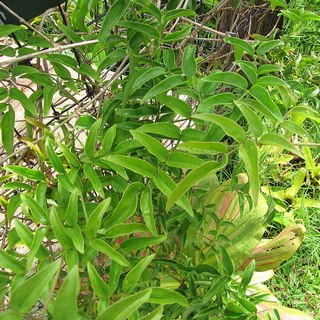
The flowers only last for a few weeks, so don’t expect your vine to look like a picture all year. However, even when not in bloom, it’s still an attractive vine that usually keeps its leaves all year. Here’s what it looks like when not in bloom.
Pink jasmine is a moderate, rather than low, water use plant, and needs more water than many desert vines.
Optimal Growing Conditions
If you’re thinking of adding a pink jasmine to your garden, you need to find a suitable place that will keep it healthy and looking good… while minimizing maintenance for you.
Here are the key factors to keep in mind.
Temperature
Pink jasmine should be grown in USDA Hardiness Zones 9 to 11. This evergreen vine is cold hardy to 25°F. It blooms prolifically in the spring, but stops blooming once the heat arrives.
Sun Exposure
Pink jasmine can be grown in full sun, as long as you give it plenty of water, but it prefers part shade. As a semi-tropical plant, it does not appreciate full desert sun (especially afternoon sun) and cannot tolerate reflected heat.
It can grow in full shade, but will have fewer flowers.
Size and Growth Rate
Pink jasmine is a fast-growing vine that typically reaches a size of 15 to 20 feet tall by 5 to 10 feet wide.
Soil
Pink jasmine prefers rich, moist but well-draining soil. So, as you can imagine, sandy, rocky, or clay desert soil is not ideal.
Other Location Considerations
Plant pink jasmine up close where people can appreciate its fragrance.
This twining vine readily grows up any nearby support structure, such as a trellis, lattice, or fence. It forms a dense screen that makes an attractive wall of green even when it’s not in bloom. It can be used as a ground cover, provided it gets some relief from the sun. It won’t be happy scrambling over sunbaked gravel.
It does best when grown along east or north facing walls. The sun and heat along south or west facing walls are too intense.
Since it’s a moderate size vine, it can be grown in large containers. Growing it in a container lets you move your plant around as the seasons change to keep it out of full sun. Growing pink jasmine in a pot also lets you provide the rich, moist soil it prefers.
Pink Jasmine:
The Essentials
| Common Name | Pink jasmine |
| Scientific Name | Jasminum polyanthum |
| Origin | China |
| Plant Type | Evergreen vine |
| USDA Zones | Zones 9 – 11 |
| Cold Hardiness | 25℉ |
| Flower Color | Pink, white |
| Flower Season | Spring |
| Mature Size | 15-20′ high x 5-10′ wide |
| Growth Rate | Fast |
| Sun Tolerance | Full, part sun |
| Water Needs | Moderate |
| Garden Friendly | No thorns, not toxic |
| Pests & Diseases | None |
| Wildlife | Attracts butterflies |
How to Plant
The rule of thumb when planting any vine in the desert is to dig a hole three times as wide as the root ball but no deeper. Since pink jasmine prefers fertile soil, consider amending your hole with compost or a commercial soil mix.
Top with organic mulch rather than gravel, which helps to retain moisture and increase soil fertility.
When to Plant
You’ll usually see pink jasmine in garden centers in the spring when its sweet fragrance beckons. However, the best time to plant one is in the fall. This gives it three seasons to grow roots and get established before the following summer.
The second best time is in spring, the earlier the better. This still gives it time to get established before the intense heat of June arrives.
How to Care for Pink Jasmine
Whether you’ve recently planted a pink jasmine or have an existing vine in your yard, here’s how to take care of it to keep it healthy and looking its best.
How to Water New Plants
Once you’ve got your pink jasmine in the ground, watering is your most immediate concern. Here is a recommended watering schedule for new vines planted in the spring or fall.
| Weeks 1 & 2 | Every 3 – 4 days |
| Weeks 3 & 4 | Every 6 – 7 days |
| Weeks 5 & 6 | Every 7 – 10 days |
| Weeks 7 & 8 | Every 10 – 14 days |
After week 8, gradually revise your watering schedule, depending on the season.
How to Water Established Plants
Pink jasmine is considered a moderate water use plant and, therefore, will need more frequent watering than your native or desert-adapted plants. Here’s a suggested watering schedule.
| Spring & Fall | Every 10 days |
| Summer | Every 7 days |
| Winter | Every 14 days |
Should You Fertilize?
Since pink jasmine prefers fertile soil and is a prolific bloomer, it benefits from an application of fertilizer in the spring. However, be aware that too much nitrogen encourages leaf formation at the expense of flowers.
How to Prune
Prune pink jasmine in the spring after it’s done flowering to thin, shape, or control its size. Pruning in the spring also encourages new growth.
Don’t Confuse Pink Jasmine With…
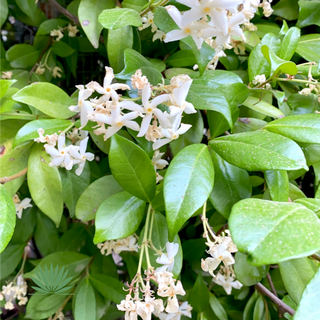
Pink jasmine is sometimes confused with star jasmine (Trachelospermum jasminoides). Both are highly fragrant vines with white star-shaped flowers that are grown as desert landscape plants.
Star jasmine flowers are white throughout their lifecycle (no pink buds). This is a somewhat smaller vine that’s a better choice for small spaces. It’s also more cold hardy (down to 10℉), if that’s a concern for you.
Despite the name “jasmine”, it’s not botanically related to true jasmines.
Plant Lover Facts
Pink jasmine (Jasminum polyanthum) also goes by the common names French perfume, winter jasmine, or many-flowered jasmine.
Not all plants called “jasmine” are true jasmines, but as a member of the Jasminum genus, pink jasmine is a true jasmine.
The species name polyanthum means “many flowers”.
It’s native to South Central China and Myanmar. It has naturalized in Great Britain and Nepal, and is considered an invasive species in Australia and New Zealand.
Did you enjoy this article?
Sign up for our weekly newsletter
where you’ll find more great info on creating &
maintaining a beautiful, carefree desert landscape.
Author Bio
Deane Alban is the creator of Southwest Gardener. She is a science writer with a bachelor’s degree in botany from the University of South Florida. Gardening is her lifelong passion. She’s been gardening in Tucson for over 15 years.

Photo Credit
Forest & Kim Starr, CC BY 3.0, via Wikimedia Commons