
Orchid tree is a large shrub or small tree that bursts forth with either white or pink flowers in the spring. Here’s everything you need to know about growing this deceptively delicate-looking Chihuahuan Desert native in this complete care guide.
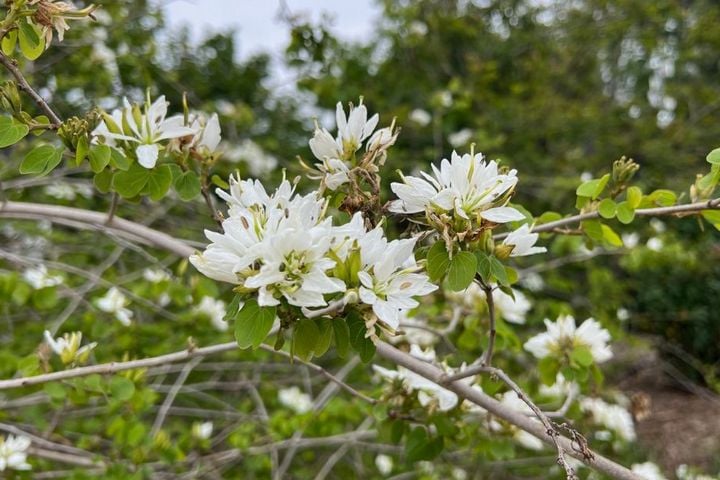
Orchid tree (Bauhinia lunarioides) is an airy plant with a tropical sounding name that is, in fact, a tough Chihuahuan Desert native that’s tolerant of desert heat, sun, and aridity.
It has small, bright green leaves shaped like butterflies. Its dainty, fragrant flowers are usually white, but some plants have pink flowers. Flowers are followed by bean-like pods.
This is a good plant for supporting wildlife. Flowers attract bees, butterflies, and hummingbirds. It’s a larval host for some butterfly species.
Why I Like This Plant
- Bright green leaves
- Beautiful fragrant flowers
- Low maintenance desert native
- Attracts birds, bees, butterflies
Things to Watch Out For
While it’s a beautiful plant, its name is a bit of a misnomer. Orchid tree’s natural form is more like a shrub than a tree, and its flowers don’t look like typical orchid blooms.
It naturally grows as a shrub. If you want yours to grow as a small, multi-trunk tree, you will need to train it.
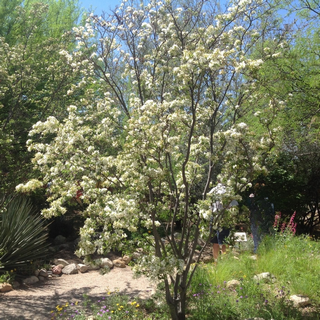
Orchid tree produces some litter. It may or may not be evergreen, depending on how mild your winters are, so it may shed its leaves. It typically sheds some old leaves every spring before new growth appears. It may also lose some leaves during extreme drought. It drops 3 inch pods during the summer.
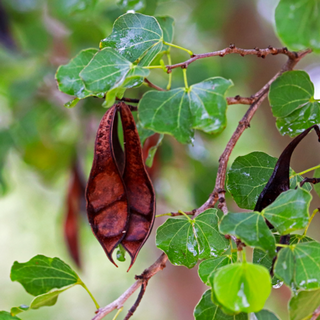
Its wood is brittle, so don’t try to grow one if you live in a windy area or your yard is a wind tunnel.
Optimal Growing Conditions
If you’re thinking of adding an orchid tree to your garden, you need to find a suitable place that will keep your plant healthy and looking good… while minimizing maintenance for you.
Here are the key factors to keep in mind.
Temperature
Orchid tree should be grown in USDA Hardiness Zones 8 to 11. As a Chihuahuan Desert native, it tolerates desert heat. It’s considered cold-hardy down to 15℉, but plants have been known to survive down to 10℉.
Sun Exposure
Orchid tree can be grown in either full sun or part shade. Avoid planting where it would receive reflected sun off of garden walls or buildings.
Plants grown in sun have denser foliage than those grown in part shade.
Size and Growth Rate
Orchid tree grows moderately fast and reaches a size of 12 to 15 feet tall by 6 to 8 feet wide. If you grow it as a shrub rather than a tree, you can easily keep it smaller by pruning.
Its growth rate and size depend somewhat on how much water it receives.
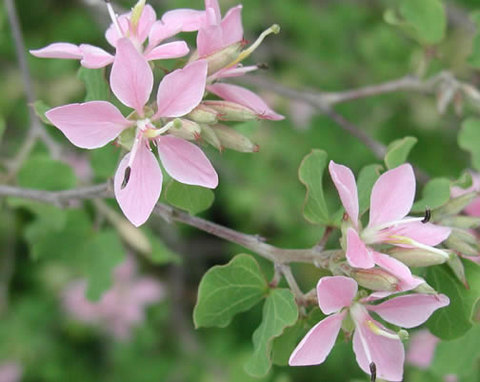
It typically blooms in late winter or spring, and may occasionally bloom again in the fall. Most plants have white flowers but some have a pastel shade of pink instead.
Soil
In its native habitat, orchid tree grows in rocky or sandy alkaline soil, but it will grow in any type of desert soil, provided it’s well-draining.
Other Location Considerations
Orchid tree makes a nice patio tree for small spaces. It can be grown in a large container.
Orchid Tree:
The Essentials
| Common Name | Orchid tree |
| Scientific Name | Bauhinia lunarioides |
| Origin | Texas, Mexico |
| Plant Type | Semi-deciduous tree |
| USDA Zones | Zones 8 – 11 |
| Cold Hardy | To 15℉ |
| Flower Color | White, pink |
| Flower Season | Late winter, spring |
| Mature Size | 12-15’ tall x 6-8′ wide |
| Growth Rate | Moderate to fast |
| Sun Tolerance | Full, part sun |
| Water Needs | Low to moderate |
| Pests & Diseases | None |
| Garden Friendly | No thorns, non-toxic |
| Wildlife | Attracts butterflies, bees, hummingbirds |
How to Plant
The rule of thumb when planting any tree or shrub in the desert is to dig a hole three times as wide as the root ball but no deeper.
Amending the soil is not recommended. Counterintuitively, backfilling with the same native soil you just dug up helps your orchid tree develop a stronger root system.
When to Plant
The best time to plant orchid tree is in the fall. This gives it three seasons to grow roots and get established before the following summer.
The second best time is in spring, the earlier the better. This still gives it time to get established before the intense heat of June arrives.
How to Care for Orchid Tree
Whether you’ve recently planted a new orchid tree or have an existing one in your yard, here’s how to take care of it to keep it healthy and looking its best.
How to Water New Plants
Once you’ve got your tree in the ground, watering is your most immediate concern. Here is the recommended watering schedule for new trees planted in the spring or fall.
| Weeks 1 & 2 | Every 3 – 4 days |
| Weeks 3 & 4 | Every 6 – 7 days |
| Weeks 5 & 6 | Every 7 – 10 days |
| Weeks 7 & 8 | Every 10 – 14 days |
After week 8, gradually extend the time between waterings.
How to Water Established Plants
As your tree becomes established, there are two watering factors to consider.
- First is how often to water. This will vary with the seasons.
- Second is how much water to give your tree with each watering. This depends on the current size of your tree.
To determine the ideal watering schedule for any desert tree, you’ll find everything you need to know, including easy-to-use charts, at How to Water Desert Trees: How Often? How Much?
Note that since orchid tree is a moderate, rather than low water use plant, use the “High Water Use” schedule, at least until it’s established. It will become more drought tolerant as it matures.
In its native habitat, it can survive on as little as 12″ of annual rainfall, but I don’t recommend trying this. Plants grow faster and have more flowers with adequate irrigation.
Should You Fertilize?
Fertilizing orchid tree is not recommended. It can result in weak, lanky growth and may reduce the number of flowers.
As a Chihuahuan Desert native, this plant evolved to get all the nutrients it needs from desert soil. And as a member of the legume family (Fabaceae), it fixes nitrogen, which naturally improves its surrounding soil.
How to Prune
If you let your orchid tree grow as a shrub, it won’t need much pruning. In the spring, remove any branches that are dead or damaged. After it’s done blooming, you can further prune to shape or control size.
But if you want to grow it as a small tree, it will need to be shaped. Unless pruning multi-trunked desert trees is a skill you have mastered, I strongly urge you hire a certified arborist. If not pruned correctly from the start, it may never acquire the shape you want.
It tends to produce suckers at the base. You should remove these as soon as you notice them. Pinching them off with your fingers as soon as they appear will result in fewer scars on your tree’s trunk than clipping them off later.
Don’t Confuse Orchid Tree With…
Orchid tree is not the only member of the Bauhinia genus with this common name, so it’s easily confused with other species. Here are some other “orchid trees” that you may come across, plus their origins.
- Bauhinia divaricata – Mexico
- Bauhinia macranthera – Mexico
- Bauhinia purpurea – Indian subcontinent
- Bauhinia variegata – Indian subcontinent, China
- Bauhinia x blakeana – hybrid of B. purpurea and B. variegata
These other species vary in appearance and other significant ways including size, cold tolerance, and water usage.
For Plant Lovers
Orchid tree (Bauhinia lunarioides) also goes by the common names Texas plume, Chihuahuan orchid tree, and anacacho orchid tree.
It’s native to only a few counties in Texas and in northeastern Mexico, where it can be found growing in canyons and washes.
The genus Bauhinia is named after the Swiss botanists John Bauhin and Caspar Bauhin. (Yes, they were brothers.) The species name, luniarioides, means moon-like (possibly referring to the shape of the leaves?).
Did you enjoy this article?
Sign up for our weekly newsletter
where you’ll find more great info on creating &
maintaining a beautiful, carefree desert landscape.
Author Bio
Deane Alban is the creator of Southwest Gardener. She is a science writer with a bachelor’s degree in botany from the University of South Florida. Gardening is her lifelong passion. She’s been gardening in Tucson for over 15 years.
