
Mt. Lemmon marigold is a large, airy perennial that has yellow daisy-like flowers and aromatic leaves. It blooms most prolifically in the fall, when many other desert flowers are fading. Here’s how to grow and care for this Sonoran Desert native wildflower.
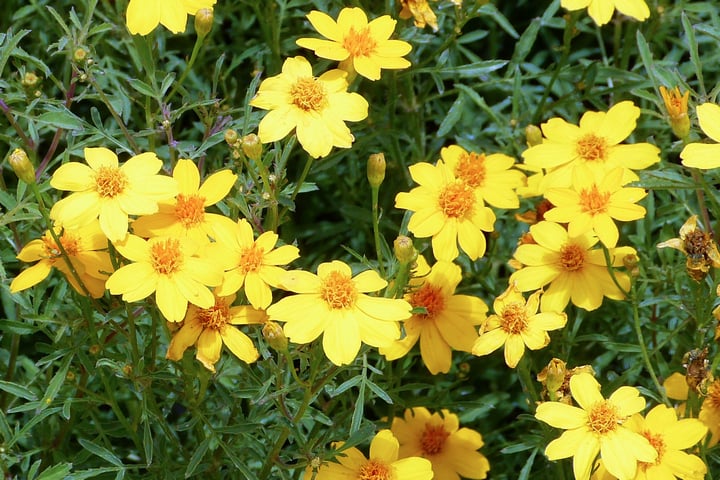
Mt. Lemmon marigold (Tagetes lemmonii) is a large, billowy shrubby perennial with fine green leaves that have the unmistakable scent of marigolds, especially when crushed or brushed against.
While this plant blooms in spring and summer, its best display is in the fall when it’s covered with cheerful lemon-yellow flowers with orange centers. Flowers can continue until the first frost.
Mt. Lemmon marigold provides food for seed-eating birds and nectar for native bees and butterflies. But browsing mammals and insects generally leave this plant alone due to its pungent aroma.
Why I Like This Plant
- Cheerful yellow fall flowers
- Usually evergreen
- No thorns, low-litter, non-toxic
- Attracts bees, birds, butterflies
Why is it “Lemmon”, not “lemon”?
Lemmon refers to Sara Lemmon, a renowned botanist.
The name has nothing to do with the citus tree.
Things to Watch Out For
Mt. Lemmon marigold is native to southern Arizona and northern Mexico. It is not a low-desert plant — it grows at elevations between 4,000 and 8,000 feet in canyons and grasslands, along streams, or on cliffs. Consequently, it’s not ideally suited to the driest, hottest spot in your yard.
People either love or hate the fragrance, which is usually described as a typical marigold scent with notes of lemon and mint. I recommend you take a whiff at the garden center before planting one in case you fall into the “hate it” camp.
Handling Mt. Lemmon marigold can cause dermatitis in some people.
Optimal Growing Conditions
If you’re thinking of adding a Mt. Lemmon marigold to your garden, you need to find a suitable place that will keep your plant healthy and looking good.
Here are the key factors to keep in mind.
Temperature
Mt. Lemmon marigold should ideally be grown in USDA Hardiness Zones 7 – 11. It tolerates desert heat up to about 100°F. In areas where it’s frequently hotter than that, it should be planted in part shade and given additional water to mitigate heat stress.
It survives temperatures into the teens, but dies back after hard freezes. During mild winters, it may stay evergreen.
Sun Exposure
Mt. Lemmon marigold can be grown in full or part sun. When grown in full sun, it appreciates some afternoon shade.
Size and Growth Rate
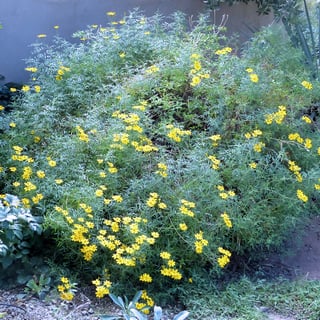
Mt. Lemmon marigold grows fast and its mature size can vary greatly. It typically reaches a size of 3 feet tall and wide when grown in the desert. But in the right spot with the right care, it can grow to be twice that size.
Soil
Mt. Lemmon marigold tolerates most types of desert soil — sand, clay, loam — but it prefers the fertile, well-draining soil of its native habitat.
Mt. Lemmon Marigold:
The Essentials
| Common Name | Mt. Lemmon marigold |
| Scientific Name | Tagetes lemmonii |
| Origin | Arizona, Mexico |
| Plant Type | Shrubby perennial |
| USDA Zones | Zones 7 – 11 |
| Cold Hardiness | To 15℉ |
| Flower Color | Yellow |
| Flower Season | Spring, summer, fall |
| Mature Size | 3-6′ high x 6-8′ wide |
| Growth Rate | Fast |
| Sun Tolerance | Full, part sun |
| Water Needs | Low |
| Pests & Diseases | None |
| Garden Friendly | No thorns, low litter, non-toxic |
| Wildlife | Attracts bees, birds, butterflies |
How to Plant
The rule of thumb when planting any perennial in the desert is to dig a hole twice as wide as the root ball but no deeper.
Since Mt. Lemmon marigold prefers fertile soil, you may want to amend your hole with compost or a commercial soil mix.
Top with organic mulch rather than gravel to retain moisture, increase soil fertility, and protect roots from temperature extremes.
When to Plant
The best time to plant perennials is in the fall. This gives your Mt. Lemmon marigold three seasons to grow roots and get established before the following summer.
The second best time is in spring, the earlier the better. This still gives your plant time to get established before the intense heat of June arrives.
Growing From Seed
Mt. Lemmon marigolds can easily be grown from seeds. One nursery that will ship them is Borderlands Nursery & Seed in Patagonia, AZ. Sow the seeds in the spring after the last frost.
How to Care for Mt. Lemmon Marigold
Whether you’ve recently planted a Mt. Lemmon marigold or have an existing one in your yard, here’s how to take care of it to keep it healthy and looking its best.
How to Water
During the first growing season, give your plant about 1/2 gallon of water every two to three days for the first few weeks, then every four to seven days while it’s getting established.
After that, the University of Arizona recommends watering desert perennials on this schedule:
| Spring (March – May) | 10 – 14 days |
| Summer (May – Oct.) | 7 – 10 days |
| Fall (Oct. – Dec.) | 10 – 14 days |
| Winter (Dec – March) | 14 – 21 days |
Then, after the first year, you can cut back on water even further. Water every week or two during summer, and once per month in the winter.
Too much water results in leggy plants with fewer flowers.
Should You Fertilize?
Since Mt. Lemmon marigolds prefer fertile soil, they can benefit from an annual application of fertilizer in the spring.
How to Prune
It’s recommended that you prune Mt. Lemmon marigold twice per year. Cut it back severely in late winter to remove cold-damaged growth and then again in early summer after the spring flowers have faded. Pruning keeps plants vigorous, promotes flowering, and keeps their size under control.
Plant Lover Facts
Mt. Lemmon marigold (Tagetes lemmonii) goes by a long list of other common names including Lemmon’s marigold, Copper Canyon daisy, mountain marigold, bush marigold, Mexican bush marigold, and shrub marigold.
It belongs to the same genus (Tagetes) as typical garden marigolds.
When I first learned of this plant, I assumed it was unique to or most prevalent on Tucson’s Mt. Lemmon, but that’s not the case.
The species lemmonii is not named after Mount Lemmon, at least not directly. The plant is named after John Lemmon — Mount Lemmon was named in honor of John’s wife, Sara. Both John and Sara Lemmon were renowned botanists who travelled throughout the southwest and are credited with discovering and cataloging over 150 plant species. The Lemmons discovered this plant in Cochise County’s Huachuca Mountains.
Did you enjoy this article?
Sign up for our weekly newsletter
where you’ll find more great info on creating &
maintaining a beautiful, carefree desert landscape.
Author Bio
Deane Alban is the creator of Southwest Gardener. She is a science writer with a bachelor’s degree in botany from the University of South Florida. Gardening is her lifelong passion. She’s been gardening in Tucson for over 15 years.
