
With fern-like leaves and bright purple flowers, moss verbena makes a delightful, low-maintenance ground cover. Here’s how to grow and care for this South American native.
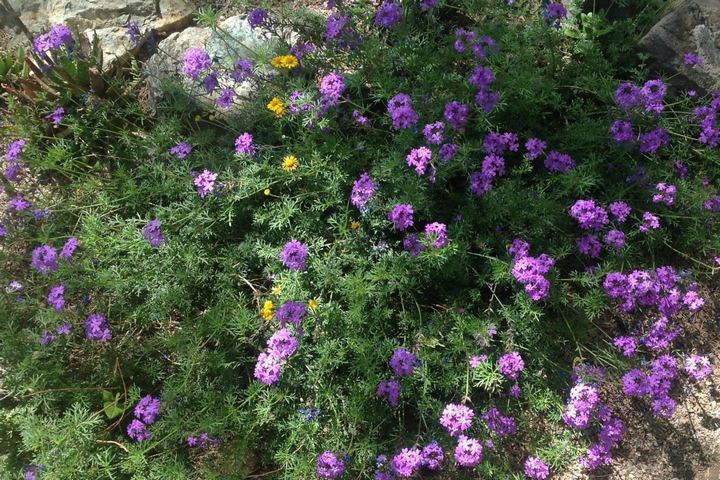
Moss verbena (Glandularia tenera) is an evergreen ground cover that’s carpeted with lantana-like clusters of bright purple flowers spring through fall.
With its lacy, fern-like foliage and airy form, it may appear delicate, but this resilient plant tolerates the desert’s temperature extremes, sun, and aridity. (According to Arizona State University, moss verbena is the best verbena to grow in the challenging Phoenix area.)
It can establish new roots where stems come in contact with the soil, forming large mats.
Moss verbena provides a source of nectar for bees and butterflies. Deer and rabbits generally leave it alone.
Why I Like This Plant
- Deep purple flowers spring through fall
- Stays evergreen in mild winters
- Low maintenance
- No thorns, low litter, non-toxic
- Attracts bees, butterflies
Things to Watch Out For
Don’t grow moss verbena where it may be stepped on — it does not hold up to foot traffic.
Moss verbena is a short-lived perennial that often declines after a few years. Some gardeners treat it like an annual and replace it yearly.
If you’re looking for a longer-lived alternative, consider Goodding’s verbena, a southwest desert native that readily reseeds for a steady supply of replacement plants.
Optimal Growing Conditions
If you’re thinking of adding moss verbena to your garden, you need to find a suitable place that will keep your plant healthy and looking good.
Here are the key factors to keep in mind.
Temperature
Moss verbena should be grown in USDA Hardiness Zones 9 to 11. It tolerates desert heat and cold down to 15℉. During extreme heat, it may go dormant during the summer, but comes back to life in the fall.
Sun Exposure
Plant moss verbena in either full sun or part shade. When grown in the hottest areas, it benefits from some afternoon shade. When grown in part shade, it will produce more foliage and fewer flowers.
Size and Growth Rate
Moss verbena grows low and wide moderately fast. When grown in full sun, it hugs the ground, staying less than 6 inches tall, but when grown in part shade it will reach around a foot tall. Plants typically spread 3 to 6 feet wide.
Soil
Moss verbena prefers growing in rocky or sandy soil, but it will grow in any type of desert soil, provided it’s well-draining.
Other Location Considerations
Moss verbena is non-toxic and low litter, making it a good choice near a pool, sidewalk, or anywhere it might come in contact with pets or people.
It’s low growing form makes it a great addition to rock gardens or as an edging plant. Use it to cover banks or slopes and for erosion control.
Moss verbena can be grown in containers, and some gardeners grow it this way, treating it as a flowering annual. A few cultivars are available in pink or white.
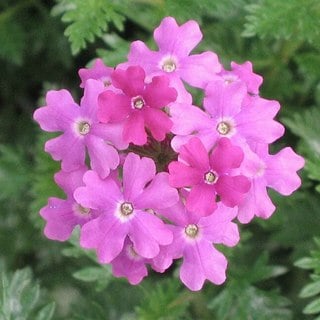
Moss Verbena:
The Essentials
| Common Name | Moss verbena |
| Scientific Name | Glandularia tenera |
| Origin | South America |
| Plant Type | Perennial ground cover |
| USDA Zones | Zones 9 – 11 |
| Cold Hardiness | To 15℉ |
| Flower Color | Purple |
| Flower Season | Spring, summer, fall |
| Mature Size | ½ -1′ high x 3-6’ wide |
| Growth Rate | Moderate to fast |
| Sun Tolerance | Full, part sun |
| Water Needs | Low |
| Pests & Diseases | Root rot |
| Garden Friendly | No thorns, low litter, non-toxic |
| Wildlife | Attracts bees, butterflies |
How to Plant
The rule of thumb when planting any ground cover in the desert is to dig a hole twice as wide as the root ball but no deeper.
Amending the soil is not recommended. Counterintuitively, backfilling with the same native soil you just dug up helps your verbena develop a stronger root system.
When to Plant
The best time to plant moss verbena is in the fall. This gives it three seasons to grow roots and get established before the following summer.
The second best time is in spring, the earlier the better. This still gives it time to get established before the intense heat of June arrives.
How to Care for Moss Verbena
Whether you’ve recently planted a moss verbena or have an existing one in your yard, here’s how to take care of it to keep it healthy and looking its best.
How to Water
The University of Arizona recommends watering newly planted, low water use ground covers on this schedule.
| Weeks 1 – 4 | Every 2 – 3 days |
| Weeks 5 & 6 | Every 6 – 7 days |
| Weeks 7 & 8 | Every 10 – 14 days |
Give your verbena about ½ gallon with each watering.
After that, you can water it on this schedule:
| Spring (March – May) | 10 – 14 days |
| Summer (May – Oct.) | 7 – 10 days |
| Fall (Oct. – Dec.) | 10 – 14 days |
| Winter (Dec – March) | 14 – 21 days |
As it grows, it will need more water with each watering, depending on its diameter. Use this chart as a guide.
| 1′ diameter | .5 gallons |
| 2′ diameter | 2 gallons |
| 3′ diameter | 3.5 gallons |
| 4′ diameter | 5 gallons |
Moss verbena needs to dry out in between waterings. Overwatering will lead to fewer flowers and can cause root rot.
Should You Fertilize?
Moss verbena naturally thrives in poor, sandy soil and does not need to be fertilized.
How to Prune
Moss verbena doesn’t need much pruning, but you can trim it lightly to shape and control size, or to remove cold damage. Trim it in late winter or early spring, or anytime it’s taking a pause from flowering.
Don’t Confuse Moss Verbena With…
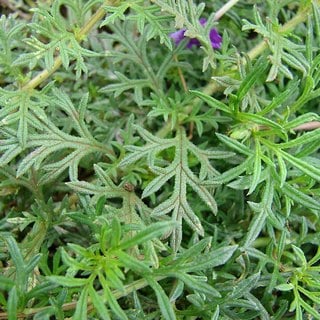
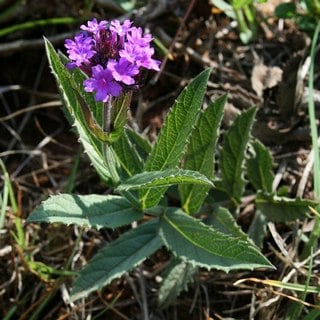
Don’t confuse moss verbena with sandpaper verbena (Verbena rigida). Both are evergreen ground covers that have clusters of purple flowers. You can easily tell them apart by looking at their leaves.
Moss verbena has lacy, fern-like leaves.
Sandpaper verbena, on the other hand, has relatively large, oblong leaves that feel rough, as its name implies.
Plant Lover Facts
Moss verbena is also called rock verbena and South American mock vervain.
It’s said to have gotten the name moss verbena, because the lacy leaves look somewhat like moss.
It is native to Argentina, Brazil, Paraguay, and Uruguay. In the US, it has escaped cultivation across the south from Florida and South Carolina to Arizona and California, and all states in between.
Glandularia tenera is moss verbena’s current correct scientific name, but a surprising number of previous names are still in use, including Glandularia pulchella, Verbena tenera, Verbena tenuisecta, Verbena geraniifolia, and Verbena pulchella.
Did you enjoy this article?
Sign up for our weekly newsletter
where you’ll find more great info on creating &
maintaining a beautiful, carefree desert landscape.
Author Bio
Deane Alban is the creator of Southwest Gardener. She is a science writer with a bachelor’s degree in botany from the University of South Florida. Gardening is her lifelong passion. She’s been gardening in Tucson for over 15 years.

Photo Credits
Mountain States Wholesale Nursery
HQ Flower Guide, CC BY-SA 2.0, Wikimedia Commons
Forest & Kim Starr, CC BY-SA 3.0, Wikimedia Commons
Franz Xaver, CC BY-SA 4.0, Wikimedia Commons