
Mastic is an evergreen that can be grown as a tree or a large shrub. It is often considered one of the “cleanest” trees you can grow in the desert southwest. Here’s everything you need to know about planting and caring for this Mediterranean native.
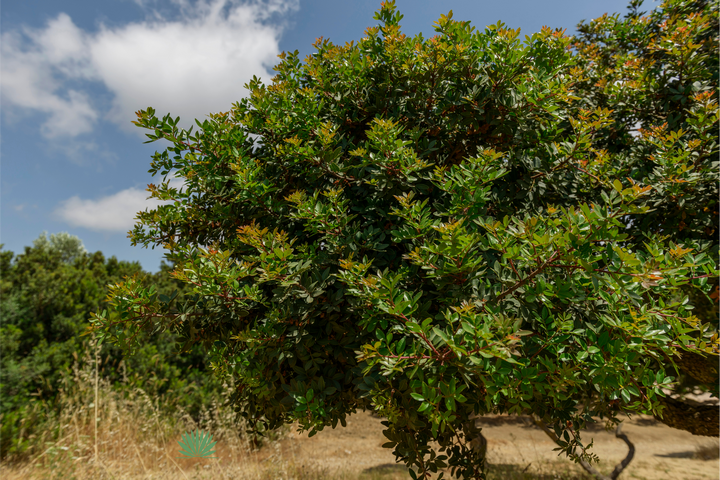
Mastic (Pistacia lentiscus) is a large, evergreen shrub native to the dry regions of the Mediterranean. But in the desert southwest, it’s commonly trained to grow as a medium size, multi-trunk tree that is often referred to as mastic tree.
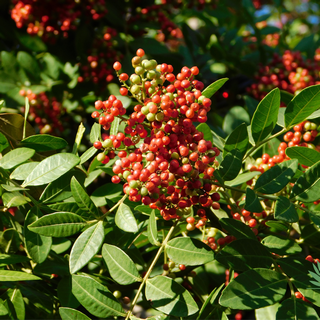
It has small, leathery, prominently-veined, aromatic leaves and a dense, rounded crown. Its flowers are inconspicuous, and plants “may” bear small red-to-black fruits that birds enjoy. (The fruits are edible, but not particularly tasty.)
This resilient plant thrives in the extreme temperatures, harsh sun, and poor rocky soil of the desert southwest.
If you’re looking for an evergreen that is low on litter, it is widely considered one of the “cleanest” trees you can grow in the desert southwest.
The term mastic is also used to describe the valuable resin that can be collected from the sap of this plant.
Why I Like This Plant
- Attractive evergreen tree or shrub
- Thrives in extreme environments
- No thorns, non-toxic, low litter
- Attracts birds
Things to Watch Out For
Mastic naturally grows as a large, dense shrub and will require significant selective pruning if you choose to grow it as a tree. (And this is a job best left to professionals to do it right.)
Mastic is dioecious (i.e., separate male and female plants). If you specifically want a mastic that bears fruit, start with a female plant. But unless there is a male tree nearby to provide pollen, the female won’t produce berries, so you would need to plant one of each.
Optimal Growing Conditions
If you’re thinking of adding a mastic tree to your garden, you need to find a suitable place that will keep your plant healthy and looking good… while minimizing maintenance for you.
Here are the key factors to keep in mind.
Temperature
Mastic tree should be grown in USDA Hardiness Zones 9 – 11. It’s very resilient to extreme heat and can withstand temperatures down to 15℉.
Sun Exposure
Mastic thrives in full sun, including reflected heat, but will also accept some part shade.
Size and Growth Rate
Mastic is considered a slow to moderate grower. When mature, you can expect your shrub or tree to be approximately 25 feet high and wide.
Soil
In its native Mediterranean habitat, it grows in dry and rocky areas. It’s equally at home in our poor, rocky, alkaline soil, provided it’s well-draining.
Other Location Considerations
Mastic is a garden friendly tree. It has no thorns and is non-toxic, so you can feel comfortable planting it where it might come in contact with people and pets.
Except for the occasional errant leaf, it’s nearly litter-free, making it a good choice to put near a patio, walkway, or pool.
Mastic Tree:
The Essentials
| Common Names | Mastic tree, mastic |
| Scientific Name | Pistacia lentiscus |
| Origin | Mediterranean |
| Plant Type | Evergreen tree |
| USDA Zones | Zones 9 – 11 |
| Cold Hardiness | To 15℉ |
| Flowers | Inconspicuous |
| Flower Season | Spring |
| Mature Size | 15-25’ tall & wide |
| Growth Rate | Slow to moderate |
| Sun Tolerance | Full, reflected sun |
| Water Needs | Low |
| Pests & Diseases | None |
| Garden Friendly | No thorns, non-toxic, low litter |
| Wildlife | Berries attracts birds |
How to Plant
The rule of thumb when planting any tree or shrub in the desert is to dig a hole three times as wide as the root ball but no deeper.
Amending the soil is not recommended. Counterintuitively, backfilling with the same native soil you just dug up helps your plant develop a stronger root system.
When to Plant
The best time to plant mastic tree is in the fall. This gives it three seasons to grow roots and get established before the following summer.
The second best time is in spring, the earlier the better. This still gives your plant time to get established before the intense heat of June arrives.
How to Care for Mastic
Whether you’ve recently planted a new mastic or have an existing one in your yard, here’s how to take care of it to keep it healthy and looking its best.
How to Water New Plants
Once you’ve got your mastic planted, watering is your most immediate concern. Here is the recommended watering schedule for new trees or shrubs.
| Weeks 1 & 2 | Every 3 – 4 days |
| Weeks 3 & 4 | Every 6 – 7 days |
| Weeks 5 & 6 | Every 7 – 10 days |
| Weeks 7 & 8 | Every 10 – 14 days |
After week 8, gradually extend the time between waterings.
How to Water Established Plants
As your tree becomes established, there are two watering factors to consider.
- First is how often to water. This will vary with the seasons.
- Second is how much water to give your tree with each watering. This depends on its current size.
To determine the ideal watering schedule for any desert tree, you’ll find everything you need to know, including easy-to-use charts, at How to Water Desert Trees: How Often? How Much?
Once established, mastic can go without water for a month at a time, any time of year.
Should You Fertilize?
There is no need to fertilize mastic. It evolved to grow in poor, rocky soil.
How to Prune
Mastic naturally grows as a large, dense shrub that’s wider than it is tall. It tolerates pruning and shaping and can be grown as an informal hedge.
Nurseries often carry plants that have been shaped to grow as a multi-trunk or single-trunk tree. But training it to grow as a tree is an ongoing process.
If you aren’t sure about how to create the shape you want, I strongly urge you to hire an arborist (not a so-called “landscaper”) to get your tree off to the right start. Professional help is an excellent investment that will result in a healthy, beautiful tree that will bring you joy for years to come. (These are long-lived trees that can live 100 years or more.)
You can expect to see suckers growing at the base that will need to be pruned. This is a straightforward task you can do any time of year. To minimize scars on the trunk, pinch them off with your fingers as soon as they appear.
Plant Lover Facts
Mastic (Pistacia lentiscus) is native to the Mediterranean region of Europe, Africa, and the Middle East.
The term mastic is also used to describe the resin from this tree. This extremely versatile, sweet-tasting sap is obtained from incisions made into the bark.
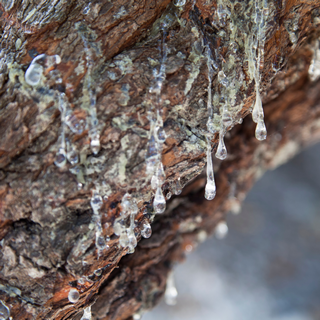
It is used as an ingredient in everything from paint and varnish to pastries and toothpaste. The ancient Romans used it to clean their teeth and freshen their breath.
It has a wide range of medicinal uses, but is used mainly for digestive disorders.
The Greek island of Chios is the primary source of commercial mastic, where it is called the “tears of Chios“.
Mastic is so important to this Greek island that they’ve built a museum — the Chios Mastic Museum — devoted to the cultivation and production of mastic.
Did you enjoy this article?
Sign up for our weekly newsletter
where you’ll find more great info on creating &
maintaining a beautiful, carefree desert landscape.
Author Bio
Deane Alban is the creator of Southwest Gardener. She is a science writer with a bachelor’s degree in botany from the University of South Florida. Gardening is her lifelong passion. She’s been gardening in Tucson for over 15 years.
