
If you’re looking for an environmentally friendly lawn substitute, check out Karupia. This patented evergreen ground cover thrives in desert heat and sun, and uses less water than grass. Mowing is optional! Learn more to discover if it’s right for you.

Are you on an endless quest to find a desert-friendly lawn substitute?
If you live in the dry southwest, you may miss expanses of green, but none of the usual options are ideal.
- Artificial turf is hot, expensive, and environmentally unfriendly.
- Traditional grass lawns are high-maintenance and thirsty, and are banned in many communities.
- Bermuda grass, the leading grass for lawns in desert gardens, can become an aggressive pest.
- Some ground covers provide a pleasant expanse of green, but can’t stand up to foot traffic.
But now there’s a relatively new option to consider — Kurapia.
What is Kurapia?
Kurapia is a low-growing, evergreen ground cover that withstands the desert’s extreme conditions.
When planted en masse, it looks and functions much like a grass lawn. (It can be mowed and you can walk on it!) But it requires less maintenance and uses less water.
Kurapia isn’t a grass. It’s a cultivar of a broadleaf ground cover called frogfruit (Phyla nodiflora). Frogfruit has a huge native range and is widespread on most continents. It grows in the southern half of the US and northward into Oregon and Pennsylvania.
Kurapia was bred from frogfruit found growing in the coastal regions of Japan. It was developed at Utsunomiya University and has been studied for use in the US by researchers at the University of California, Texas A&M University, and the University of Arizona’s Maricopa County Cooperative Extension.
Why I Like This Plant
- Evergreen grass alternative
- Low water use, low maintenance
- Tiny flowers attract pollinators
- Tolerant of extreme desert conditions
- Accepts foot traffic
Things to Watch Out For
Kurapia is not right for every situation. Here are a few important caveats to be aware of.
Foot Traffic
Kurapia has been successfully used in commercial and municipal settings, such as along roads, parking lots, and median strips.
For homeowners, Kurapia is ideal for replacing non-functional turf such as that grown on hell strips, slopes, or anywhere that grass has been planted mainly to please the eye, but is not extensively used.
Kurapia tolerates light, but not heavy foot traffic. While you can walk on Kurapia, don’t plant it where it will get heavy use by rambunctious kids or pets.
Flowers
Intermittently throughout the year, Kurapia will pepper your lawn with tiny flowers that attract bees and butterflies. You might find this to be an amazing benefit or a major concern, depending on how you use your lawn and how you feel about bees.
Soil Preparation
Since Kurapia spreads by runners, it needs loose, friable soil to grow. You can’t stick this plant in hardpan soil and expect it to thrive.
Before planting, you’ll need to provide a clean, grass-free, weed-free “blank slate”. This means removing gravel or any other inorganic mulch and weeds.
This also means removing any existing grass, especially Bermuda grass, which will overwhelm your Kurapia. And as anyone with Bermuda grass will attest, getting rid of it for good is no easy feat.
Controlling Weeds
If you’re used to having a weed-free lawn, controlling weeds in Kurapia can be a challenge, especially while it’s getting established.
Studies have found that spraying pre-emergents on Kurapia caused 20 to 25% plant damage.
However, once established, Kurapia forms a dense mat that largely suppresses weeds, but some may still poke through.
Buying Karupia
Genuine Kurapia is not easy to find. If you can’t find it locally, you can order flats of plugs from Kurapia.com.
You have a choice of flower colors — Kurapia® New White or Kurapia® Pink.
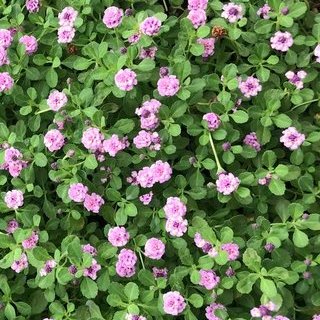
If you prefer a more manicured look, you can remove the flowers by mowing your “lawn” whenever they pop up.
Optimal Growing Conditions
Before adding Kurapia as a ground cover or lawn replacement, be sure you can provide the right conditions. Here are the key factors to keep in mind.
Temperature
Kurapia should be grown in USDA Hardiness Zones 7 and warmer. Plants have been shown to tolerate desert temperature extremes — heat up to 120℉ and cold down to 13℉.
According to the University of Arizona, it would probably not survive winters in Arizona cold spots such as Prescott, Payson, or Flagstaff.
Sun Exposure
Kurapia thrives in full or part sun. Unlike Bermuda grass, it tolerates shade.
Size and Growth Rate
Kurapia is a fast growing ground cover that, if left unmowed, tops out at around 3 inches tall. Each plug can spread a few feet within a few months.
Soil
Kurapia is tolerant of desert soil, but it’s recommended that you loosen and amend sandy or clay soil with compost for best results.
Kurapia:
The Essentials
| Common Name | Kurapia |
| Scientific Name | Lippia nodiflora (cultivar) |
| Origin | Japan |
| Plant Type | Evergreen ground cover |
| USDA Zones | 7 – 11 |
| Cold Hardiness | To 13℉ |
| Flower Color | White, pink |
| Mature Size | 3″ tall x 2-4’ wide |
| Growth Rate | Fast |
| Sun Tolerance | Full, part sun |
| Water Needs | Low once established |
| Pests/Diseases | None |
| Wildlife | Attract bees, butterflies |
Planting Kurapia
Since Kurapia’s flowers are sterile, you can’t grow it from seed. Plants are propagated from cuttings and sold as plugs. When spaced 18 inches apart, you can expect full coverage within 3 to 4 months.
You can plant Karupia any time of year, but the optimal times are early spring and late fall.
Before planting, you’ll need to provide a clean, grass-free, weed-free “blank slate.” Then the soil needs to be loosened so that your new plants can spread. If you have sandy or clay soil, it’s recommended that you top with a fine layer of compost.
How to Care for Kurapia
Here are general guidelines for how to care for Kurapia once planted.
How to Water
Watering needs vary depending on the temperature. A suggested schedule is to water once per week for 20 minutes when the temperature is 70° to 90°F and twice per week when it’s above 90°F.
How to Fertilize
Kurapia should not be fertilized immediately after planting, which can damage the plugs. Once established, fertilize it twice per year with an organic fertilizer — in spring and again in summer.
Mowing Kurapia
You can let your kurapia grow naturally as a flowering ground cover, but if you want to keep it looking more like a traditional lawn, you can mow it as little as twice per year or as often as once a month.
Before You Go
Replacing or adding a lawn is a big investment of time and energy and not an undertaking to be considered lightly. This overview is only a brief introduction to help you decide whether growing Kurapia makes sense for you.
To learn more, please refer to Kurapia.com’s support page, which is the best place to find detailed information on all aspects of growing this promising lawn substitute.
Did you enjoy this article?
Sign up for our weekly newsletter
where you’ll find more great info on creating &
maintaining a beautiful, carefree desert landscape.
Author Bio
Deane Alban is the creator of Southwest Gardener. She is a science writer with a bachelor’s degree in botany from the University of South Florida. Gardening is her lifelong passion. She’s been gardening in Tucson for over 15 years.
