
‘Joan Lionetti’ is an oak hybrid that has been selected for its tolerance of desert heat, drought, and alkaline soil. Here’s everything you need to know about planting and caring for this patented hybrid.
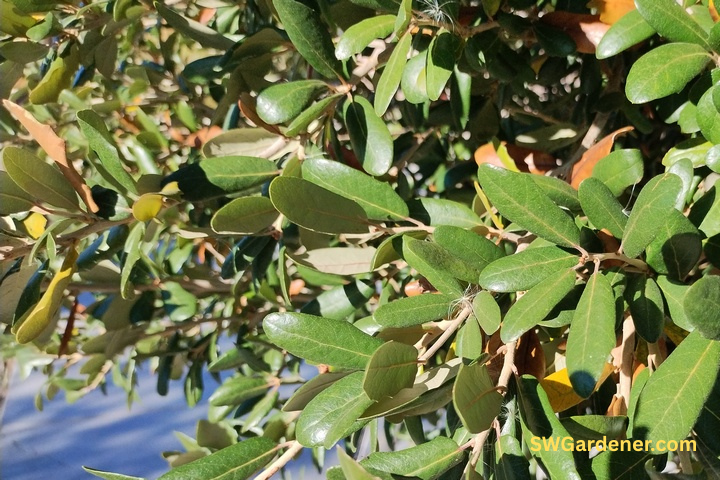
‘Joan Lionetti’ oak (Quercus virginiana x fusiformis ‘Joan Lionetti’) is a medium size evergreen tree with leathery leaves that are dark green on top and light gray on the underside. Inconspicuous flowers that bloom in the spring are followed by acorns in the fall.
‘Joan Lionetti’ is a cross between Virginia live oak (Quercus virginiana) and Texas live oak (Quercus fusiformis) that was developed by Tucson’s Civano Growers.
This patented hybrid provides a few significant benefits over either of the two parent trees. It is more tolerant of desert heat, drought, and alkaline soil.
Unlike Virginia live oak, which can reach a massive 80′ tall by 100′ wide, it stays a manageable size for urban and suburban yards, roughly 30 feet tall and wide. And unlike Texas oak, it’s not susceptible to sunscald or numerous pests and diseases.
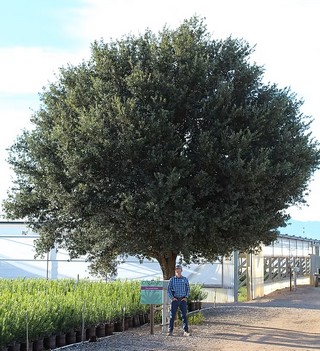
It reliably grows as a “lollipop” tree — a straight, single trunk with a round, dense canopy. This is what most people who hail from elsewhere think a tree should look like. Here’s a picture of a mature specimen at Civano Growers.
Why I Like This Plant
- Evergreen
- Stays a manageable size
- Selected for its resilience to desert extremes
- Provides dense shade
- Acorns feed wildlife
Things to Watch Out For
You may or may not be a fan of acorns. Many animals enjoy acorns, including some you may not want to attract — javelinas and rodents come to mind. My previous Tucson home had a large oak, and cleaning up acorns was a time-consuming chore.
While this tree is touted as fast-growing, that has not been my experience. Several of my neighbors have ‘Joan Lionettis’ that have barely grown in the 3 years since they’ve been planted.
This tree is considered evergreen, but as is typical of live oaks, it drops old leaves in the spring, making way for new leaves to emerge.
Optimal Growing Conditions
If you’re thinking of adding a ‘Joan Lionetti’ oak to your garden, you need to find a suitable place that will keep your plant healthy and looking good… while minimizing maintenance for you.
Here are the key factors to keep in mind.
Temperature
‘Joan Lionetti’ should be grown in USDA Hardiness Zones 7 – 11. It is tolerant of extreme heat and cold, and can withstand temperatures down to 0℉.
Sun Exposure
This tree thrives in full sun but tolerates part shade.
Size and Growth Rate
This tree’s growth rate is variable. I’ve heard it described as both fast and slow growing, but this almost certainly depends on how trees are cared for. Civano Growers claims these trees will grow 2 to 3 feet per year when properly irrigated.
You can expect your tree to reach a mature size of 30 feet tall and wide.
Soil
‘Joan Lionetti’ oak is not particular about soil and does well in any native desert soil — rocky, sandy, clay — provided it’s well-draining.
‘Joan Lionetti’ Oak:
The Essentials
| Common Name | ‘Joan Lionetti’ oak |
| Scientific Name | Quercus virginiana x fusiformis ‘Joan Lionetti’ |
| Origin | Southeastern US (hybrid) |
| Plant Type | Evergreen tree |
| USDA Zones | Zones 7 – 11 |
| Cold Hardiness | To 0℉ |
| Flower Color | Inconspicuous |
| Flower Season | Spring |
| Mature Size | 30’ high x 30’ wide |
| Growth Rate | Variable |
| Sun Tolerance | Full, part sun |
| Water Needs | Moderate |
| Pests & Diseases | None |
| Garden Friendly | No thorns |
| Wildlife | Acorns attract birds, mammals |
How to Plant
The rule of thumb when planting an oak tree in the desert is to dig a hole three times as wide as the root ball but no deeper.
Amending the soil is not recommended. Counterintuitively, backfilling with the same native soil you just dug up helps your plant develop a stronger root system.
When to Plant
The best time to plant an oak is in the fall. This gives your tree three seasons to grow roots and get established before the following summer.
The second best time is in spring, the earlier the better. This still gives your plant time to get established before the intense heat of June arrives.
How to Care for ‘Joan Lionetti’ Oak
Whether you’ve recently planted a new ‘Joan Lionetti’ oak or have an existing one in your yard, here’s how to take care of it to keep it healthy and looking its best.
How to Water New Plants
Once you’ve got your ‘Joan Lionetti’ in the ground, watering is your most immediate concern.
Here is the recommended watering schedule for new trees planted in the spring or fall.
| Weeks 1 & 2 | Every 3 – 4 days |
| Weeks 3 & 4 | Every 6 – 7 days |
| Weeks 5 & 6 | Every 7 – 10 days |
| Weeks 7 & 8 | Every 10 – 14 days |
How to Water Established Plants
As your tree becomes established, there are two watering factors to consider.
- First is how often to water. This will vary with the seasons.
- Second is how much water to give your tree with each watering. This depends on its current size.
To determine the ideal watering schedule for any desert tree, you’ll find everything you need to know, including easy-to-use charts, at How to Water Desert Trees: How Often? How Much?
Water deeply and regularly for the first two years to establish an extensive root system.
Once your tree is established, it won’t need much water. By the third year, it should only need one deep watering during summer and even less the rest of the year.
Should You Fertilize?
‘Joan Lionetti’ oak will grow just fine without fertilizer, however, Tucson Clean & Beautiful suggests applying a slow-release, low-nitrogen fertilizer in early spring.
But don’t overdo it. Too much fertilizer can result in excessive soft growth.
Pruning
This tree’s natural form — straight trunk and broad, symmetric canopy — requires minimal training to grow as an attractive single-trunk tree.
During the first three years, competing leaders should be removed to establish a strong central trunk. Unless you have experience pruning trees, I urge you to hire an arborist (not a so-called “landscaper”) to get your tree off to the right start. Hiring a professional is an excellent investment that will result in a tree that will be strong and beautiful for decades to come.
Once it’s established, pruning requirements are minimal and involve removing occasional dead or rubbing branches.
How to Get a ‘Joan Lionetti’ Oak on a Budget
If you live in Tucson, ‘Joan Lionetti’ oak is usually one of the selections offered in the TEP (Tucson Electric Power) Trees for You Program. If you’re a TEP customer, you’ll have the opportunity to order two 5-gallon trees for $5 each every spring and fall.
You can also buy this tree (and many others) from Trees for Tucson for $30. You can have it delivered to your home.
Plant Lover Facts
Tucson’s Civano Growers developed this tree and named it after Joan Lionetti, the founder of the not-for-profit organization Trees for Tucson. She is considered one of the driving forces behind Tucson’s sustainable gardening movement.
The very first ‘Joan Lionetti’ oak was selected from thousands of oak seedlings for its form and resilience.
This hybrid’s correct scientific name is Quercus virginiana x fusiformis ‘Joan Lionetti’ PP27646. (The PP indicates that it’s been patented.) But you’ll often see the name shortened to Quercus fusiformis ‘Joan Lionetti’.
Did you enjoy this article?
Sign up for our weekly newsletter
where you’ll find more great info on creating &
maintaining a beautiful, carefree desert landscape.
Author Bio
Deane Alban is the creator of Southwest Gardener. She is a science writer with a bachelor’s degree in botany from the University of South Florida. Gardening is her lifelong passion. She’s been gardening in Tucson for over 15 years.
