
Feathery cassia is a large evergreen shrub that puts on a showy display of sunny yellow flowers in the winter when not much else is blooming. Here’s how to plant and care for this low-maintenance Australian native.
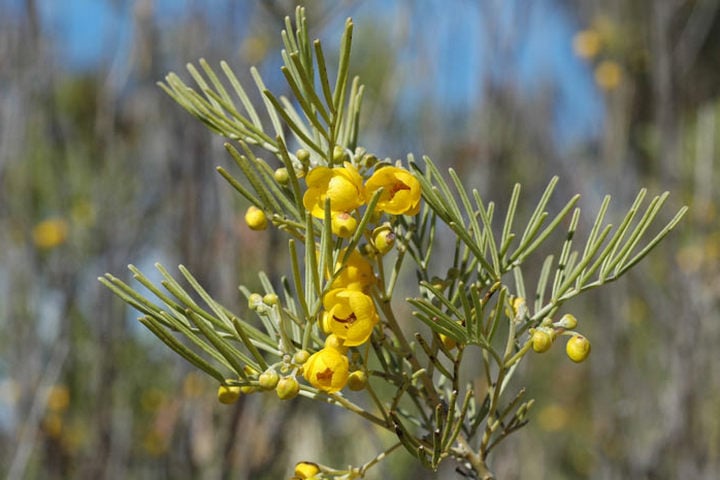
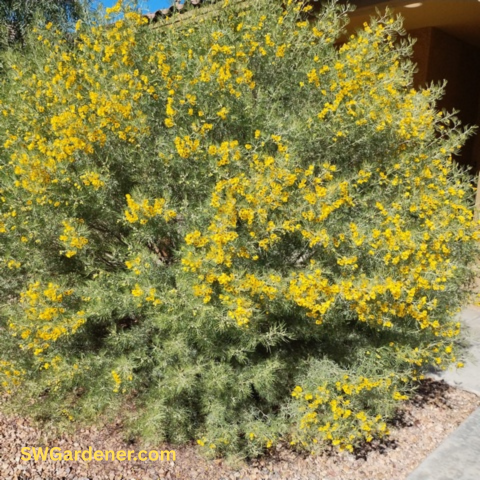
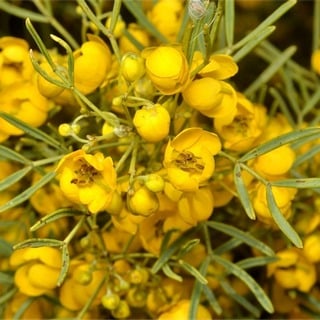
Feathery cassia (Senna artemisioides) is a large, woody, evergreen shrub with a lacy, rounded form. When in bloom, it’s smothered with masses of fragrant, pea-shaped yellow flowers.
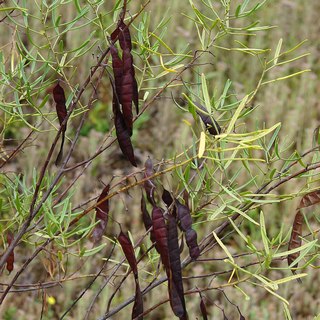
Flowers are followed by large, dangling pods that change from lime green to brown.
This shrub comes in several forms, so it may have flat, sickle-shaped leaves or fine, needle-like foliage in silver or green. (I’m partial to the silver-leaf form, which shimmers in the sun.)
Feather cassia is one of the earliest shrubs to bloom in the winter. (As I write this in mid-January, they’re in full bloom in my Tucson neighborhood.)
The sweet-smelling flowers attract butterflies and bees, and birds enjoy eating their seeds.
Why I Like This Plant
- Evergreen, attractive year round
- Yellow flowers provide winter color
- Grows fast
- Low maintenance
- No thorns, non-toxic
- Supports bees, birds, butterflies
As a winter-bloomer, it’s a great shrub for snowbirds or anyone who enjoys spending time in their garden during the winter.
What to Watch Out For
Feathery cassia is a large shrub that grows fast, so plant it where it has room to grow. Don’t rely on pruning it to keep its size in check since regular pruning will remove future flowers — one of its main features.
The seed pods are large and persistent, hanging on the plant for months. Most people find them unattractive, and if left on the plant, they can reseed aggressively. You can avoid these issues by pruning them off at the correct time of year.
There are numerous subspecies of this plant. So when you go plant shopping, don’t be surprised if you see plants called feather cassia that have different leaves. These variations all belong to the same species and need the same care.
Optimal Growing Conditions
If you’re thinking of adding a feathery cassia to your garden, you need to find a suitable place that will keep your plant healthy and looking good… while minimizing maintenance for you.
Here are the key factors to keep in mind.
Temperature
Feathery cassia should be grown in USDA Hardiness Zones 9 – 11. It is tolerant of extreme heat and survives cold down to 20℉.
Sun Exposure
Feathery cassia should be grown in full sun and doesn’t mind the reflected sun off walls and buildings.
Size and Growth Rate
Feathery cassia grows fast, reaching a size of 6 to 8 feet tall and wide in a few years, but it can grow much larger.
Soil
Feathery cassia will grow in any desert soil — clay, sand, or rocky — provided it’s well-draining. It’s prone to root rot if drainage is poor.
Feathery Cassia:
The Essentials
| Common Name | Feathery cassia |
| Scientific Name | Senna artemisioides |
| Origin | Australia |
| Plant Type | Evergreen shrub |
| USDA Zones | Zones 9 – 11 |
| Cold Hardy | To 20℉ |
| Flower Color | Yellow |
| Flower Season | Winter, early spring |
| Mature Size | 6-8’ tall x 6-8’ wide |
| Growth Rate | Fast |
| Sun Tolerance | Full, reflected sun |
| Water Needs | Low |
| Pests/Diseases | Root rot |
| Garden friendly | No thorns, non-toxic |
| Wildlife | Attracts bees, birds, butterflies |
How to Plant
The rule of thumb when planting any shrub in the desert is to dig a hole three times as wide as the root ball but no deeper.
Amending the soil is not recommended. Counterintuitively, backfilling with the same native soil you just dug up helps your plant develop a stronger root system.
When to Plant
The best time to plant feathery cassia is in the fall. This gives it three seasons to grow roots and get established before the following summer.
The second best time is in spring, the earlier the better. This still gives it time to get established before the intense heat of June arrives.
How to Care for Feathery Cassia
Whether you’ve recently planted a feathery cassia or have an existing one in your yard, here’s how to take care of it to keep it healthy and looking its best.
How to Water New Plants
Once you’ve got your feathery cassia in the ground, watering is your most immediate concern. Here is the recommended watering schedule for new shrubs planted in the spring or fall.
| Weeks 1 & 2 | Every 3 – 4 days |
| Weeks 3 & 4 | Every 5 – 7 days |
| Weeks 5 & 6 | Every 7 – 10 days |
| Weeks 7 & 8 | Every 10 – 14 days |
How to Water Established Plants
As your shrub gets established, there are two watering factors to consider.
- First is how often to water. This will vary with the seasons.
- Second is how much water to give your shrub with each watering. This depends on the current size of your plant.
To determine the ideal watering schedule for feather cassia, you’ll find everything you need to know, including easy-to-use charts, at How to Water Desert Shrubs: How Often? How Much? Since it is a low water use plant, use the “Low Water Use” schedule.
Be careful not to overwater, which can cause leaves to yellow and roots to rot.
Should You Fertilize
There is no need to fertilize feathery cassia, it grows fast and flowers profusely without fertilizer. And like all members of the legume family (Fabaceae), it fixes nitrogen, which naturally improves its surrounding soil.
How to Prune
Your landscaper might try to convince you otherwise, but pruning should not be a routine maintenance task since it removes future flowers.
Pruning should only be done in late spring after it’s done flowering and its seed pods have formed. Most people find the large, persistent seed pods unattractive and are happy to be rid of them.
Plants become straggly with age and can be pruned by half every few years. Unlike some desert shrubs that respond beautifully to a hard prune (i.e., Texas ranger), feathery cassia doesn’t always rebound.
You can help keep this plant’s size in check by reducing irrigation. Too much water promotes excessive growth and plants can get up to 15 feet tall!
Plant Lover Facts
Feathery cassia (Senna artemisioides) is commonly referred to as feathery senna. It was called cassia back when its scientific name was Cassia artemisioides, and the name stuck. And, depending on the subspecies, it can also be called hardy senna, Australian senna, green feathery senna, silver cassia, or silver leaf senna.
To say that this plant’s nomenclature is complicated is an understatement. The Australian Plant Society lists 11 subspecies of this plant, while the Australian Native Plants Society recognizes 9. Some subspecies are actually hybrids of other subspecies!
Senna artemisioides is native to Australia but it has naturalized in a few spots around the world including in Arizona and California.
You might recognize the name senna as an over-the-counter remedy for constipation. However, laxatives are derived from a different member of this genus — Senna alexandrina.
Did you enjoy this article?
Sign up for our weekly newsletter
where you’ll find more great info on creating &
maintaining a beautiful, carefree desert landscape.
Author Bio
Deane Alban is the creator of Southwest Gardener. She is a science writer with a bachelor’s degree in botany from the University of South Florida. Gardening is her lifelong passion. She’s been gardening in Tucson for over 15 years.

Photo Credits
Murray Fagg, CC BY 3.0 AU, Wikimedia Commons
Forest & Kim Starr, CC BY 3.0, Wikimedia Commons
Murray Fagg, CC BY 3.0 AU, Wikimedia Commons