
Eve’s needle is an unusual desert plant that at first glance looks more like a succulent than a cactus. It has glossy green segments and prominent leaves. It also has needle-like spines. Here’s everything you need to know about planting and caring for this native of the Andes Mountains.
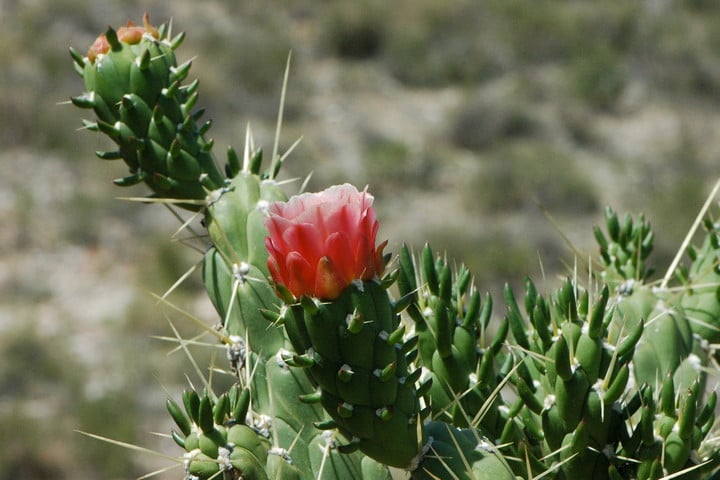
If you are looking for a landscape cactus that’s a little unusual, Eve’s needle (Austrocylindropuntia subulata) is different from most in several ways.
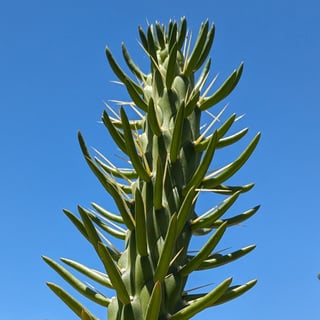
The first time I saw one, I thought it was a Euphorbia rather than a cactus. It has glossy green stems with fleshy evergreen leaves that can grow up to 5 inches long. (Leaves are not a feature associated with cactus!)
At first glance, it can appear thornless, but there are 3 inch needle-like spines nestled among its leaves, making it deceptively dangerous.
The low desert is not this plant’s home. Its native habitat is the Andes Mountains, where it grows at an altitude of 8,000 to 12,000 feet and can receive as much as 40 inches of annual rainfall. So it likes a little less sun and a little more water than most landscape cactus.
Eve’s needle rarely blooms in cultivation, but when it does, it produces showy red or pink flowers that are followed by green, oblong fruit.
Unlike native cactus, it doesn’t seem to offer any particular value to wildlife.
Why I Like This Plant
- Unusual, eye-catching cactus
- Low maintenance
- Grows fast
- Deer and rabbit resistant
Things to Watch Out For
Did I mention it has nasty, wicked spines?
This plant has become an invasive species in Australia. A government website warns that “spines can cause painful injuries to people, livestock, working dogs and pets” and “injure and sometimes kill wildlife that get trapped in the spines“. Yikes. 😧
So consider whether you want a plant this dangerous in your garden. They get big fast. Working with or around them can become an onerous task.
Optimal Growing Conditions
If you’re thinking of adding an Eve’s needle to your garden, you need to find a suitable place that will keep your plant healthy and looking good… while minimizing maintenance for you.
Here are the key factors to keep in mind.
Temperature
Eve’s needle should be grown in USDA Hardiness Zones 9 to 11. It tolerates desert heat and is cold-hardy down to around 25℉.
Sun Exposure
Grow Eve’s needle in full sun or part shade.
Since it’s not native to the low desert, it appreciates some relief from the afternoon sun. And avoid planting where it receives the reflected heat from a garden wall or building.
Size and Growth Rate
Eve’s needle is a fast growing cactus that typically reaches a size of 6 to 8 feet tall and 4 to 6 feet wide. In its native habitat it can grow 12 feet tall, but generally stays much smaller in cultivation.
Soil
Eve’s needle prefers poor, sandy, or rocky soil. Good drainage is a must.
Other Location Considerations
Avoid planting Eve’s needle where people or pets might bump into it. It can be planted in a large container which can help keep it out of reach from kids and pets.
If you grow one in a container, be sure it has good drainage and use specifically formulated cactus soil. You can expect container plants to stay smaller than those grown in the ground.
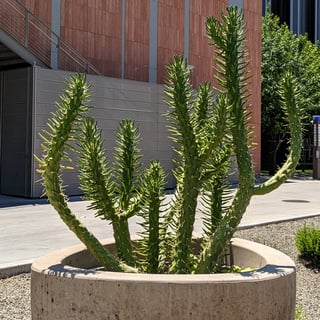
On the other hand, because it’s so dangerous, it makes an excellent barrier plant, if you’re in need of one.
Eve’s Needle:
The Essentials
| Common Name | Eve’s needle |
| Scientific Name | Austrocylindropuntia subulata |
| Origin | South America |
| Plant Type | Segmented cactus |
| USDA Zones | Zones 9 – 11 |
| Cold Hardiness | To 25℉ |
| Flower Color | Red, pink |
| Flower Season | Spring |
| Mature Size | 6-12′ high x 4-8’ wide |
| Growth Rate | Fast |
| Sun Tolerance | Full, part sun |
| Water Needs | Low |
| Pests & Diseases | Root rot |
| Cautions! | 3 inch spines |
| Wildlife | Deer, rabbit resistant |
How to Plant
To plant an Eve’s needle, dig a hole the same depth as the root system and twice as wide. Carefully remove the plant from the container, put it in the hole, and press the soil to remove any air pockets.
It’s generally recommended that you backfill with native soil and not add any amendments.
However, good drainage is critical. So if you know your soil is slow draining, amend with coarse sand or small gravel until you have a loose, well-drained mix.
Planting a spiny cactus like Eve’s needle is serious business — so be prepared. Helpful tools include tongs and old pieces of carpet or old towels. Wear long sleeves, eye protection, and sturdy, protective gloves.
Most garden gloves are no match for our spikiest desert plants. I use a thick pair of nitrile chemical-resistant gloves. I’ve handled some of the spikiest plants with these, and none have poked through yet.
When to Plant
The best time to plant cactus is in the spring or early summer when warm soil temperatures encourage root development.
How to Care for Eve’s Needle
Whether you’ve recently planted an Eve’s needle or have an existing plant in your yard, here’s how to take care of it to keep it healthy and looking its best.
How to Water
You’re probably used to giving plants a good soaking immediately after transplanting, but that isn’t the best practice with cactus. Counterintuitively, it’s better to wait a week or two after planting to water. Then use the following schedule as a guide.
| Spring & Fall | Every 3-5 weeks |
| Summer | Every 2-4 weeks |
| Winter | Only if no winter rains |
Eve’s needle may need a little more water than most landscape cactus, especially during the summer.
If you’re growing your cactus in a container, use this watering schedule as a guide.
| Spring & Fall | Every 7-10 days |
| Summer | Every 5-7 days |
| Winter | Every 10-14 days |
Should You Fertilize?
There is no need to fertilize Eve’s needle. It gets all the nutrients it needs from the surrounding desert soil. But if you grow one in a pot, fertilize it lightly once a month spring through summer.
Pruning & Propagation
Eve’s needle rarely needs pruning except to remove dead or damaged pads or to keep its size in check. If you prune, always cut it at the joints.
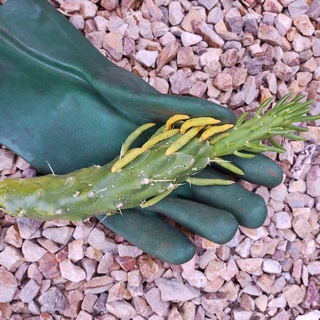
You can use any pieces that you’ve pruned or that have broken off to easily propagate new plants. Let the pads dry and callus in the shade for a week or two, and then plant them in a pot filled with cactus soil. Water minimally to avoid rot.
Plant Lover Facts
Eve’s needle (Austrocylindropuntia subulata) goes by several other common names including Eve’s needle cactus, Eve’s pin, Eve’s pin cactus, and long spine cactus.
It’s easy to see why it’s named “needle” or “pin”, but I don’t know why this cactus is named after “Eve”. If you know why, please let me know!
It’s native to Bolivia and Peru. It has naturalized in parts of Africa and southern Europe. It’s considered an invasive species in Australia, where it can form large, hazardous thickets.
Did you enjoy this article?
Sign up for our weekly newsletter
where you’ll find more great info on creating &
maintaining a beautiful, carefree desert landscape.
Author Bio
Deane Alban is the creator of Southwest Gardener. She studied journalism and received a bachelor’s degree in botany from the University of South Florida. Gardening is her lifelong passion. She’s been gardening in Tucson for over 16 years.

Photo Credits
liesvanrompaey, CC BY-SA 2.0, via Wikimedia Commons
Arizona State University’s Virtual Library of Phoenix Landscape Plants