
Looking to add color to your desert garden that extends into winter? Look no further than these plants that have either colorful flowers or leaves in the winter. You’ll find an assortment of trees, shrubs, perennials, groundcovers, and succulents that add color throughout our cool season.
Flowers and summer go together like peanut butter and jelly, but here in the desert southwest, winter, not summer, is the best time to be outside enjoying your yard.
So it makes sense that you’d want your yard to have pops of color in the winter. This is especially important if you’re a snowbird and are only here for the winter months.
Here’s a look at some of my favorite plants that provide winter color. Most have flowers, but a few have outstanding, colorful foliage.
Besides being beautiful, there’s another reason to add flowers to your winter garden. Many provide nectar for hummingbirds throughout the winter when little else is available. Here in the southwest, we are fortunate to have these flying jewels as year-round residents.
To learn more about any of these plants,
click on the link to find a comprehensive “plant profile.”
Aloes
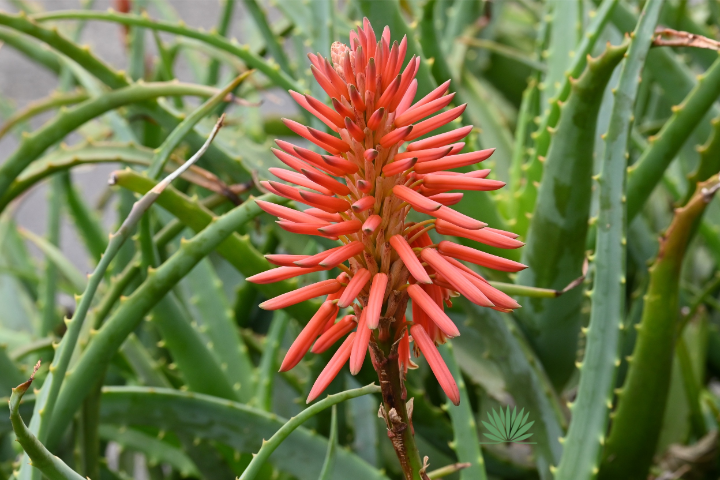
Aloe is a genus of succulents that originates in the eastern hemisphere. Every winter, they send up flower stalks with yellow, orange, coral, or red flowers, depending on the species. Even though these plants aren’t native, hummingbirds are highly attracted to their tubular flowers.
Blue elf aloe (Aloe x ‘Blue Elf’) is one of the best hybrids for long-lasting winter flowers. Its showy 2-foot flower stalks are covered with bright orange-red flowers that last several months, and contrast beautifully with the plant’s silver-blue leaves.

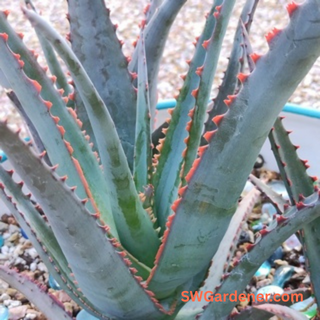
Another aloe that adds color to winter gardens in a different way is aloe ‘Diablo’ (Aloe divaricata ‘Diablo’). This large aloe has blue-green leaves lined with distinctive teeth that glow ruby red when backlit by the sun.
Angelita Daisy
Angelita daisy (Tetraneuris acaulis) is a small perennial with grass-like leaves and daisy-like flowers perched atop slender stems. It can come as a surprise to learn how tough this dainty plant is. It tolerates desert heat and can survive temperatures down to -20℉.
It grows as far north as Central Canada where it dies back in the winter, but in the desert southwest, it flowers all year.

Baja Fairy Duster
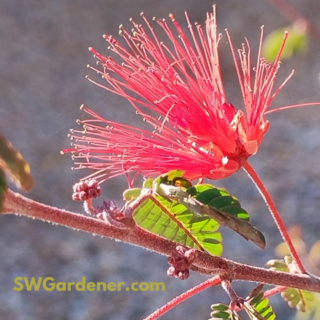
Baja fairy duster (Calliandra californica) is a lacy evergreen shrub that’s adorned with charming red flowers that look like tiny feather dusters.
It’s one of the few shrubs that blooms in all four seasons in desert gardens, making it an important year-round food source for hummingbirds and other pollinators.
Emu Bushes
Emu bushes (Eremophila spp.) are drought-tolerant Australian natives with flowers shaped like tiny lipstick tubes.
Not all emu bushes bloom in the winter here, but many do including:
- Blue bells emu (Eremophila hygrophana)
- Outback sunrise emu (Eremophila glabra ‘Mingenew Gold’)
- Valentine emu bush (Eremophila maculata ‘Valentine’)
- Winter blaze emu bush (Eremophila glabra ssp. carnosa ‘Winter Blaze’)

Bulbine
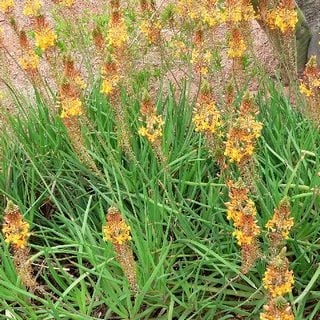
Bulbine (Bulbine frutescens) is a delightful desert plant that defies categorization. It’s been described as being a perennial, succulent, shrub, sub-shrub, or ground cover.
It has succulent leaves reminiscent of green onions. It sends up 2 foot tall flower stalks that are lined with gold or orange flowers from fall through spring.
Because it’s compact, upright, and low-litter, it’s used in rock gardens, mass plantings, small spaces, borders, containers, and raised planters in both residential and commercial settings.
Cape Honeysuckle
Cape honeysuckle (Tecoma capensis) is a versatile plant that can be grown as a vine, shrub, or ground cover, depending on how it’s trained and pruned.
Its showy clusters of red-orange flowers and contrasting glossy dark green leaves give this plant a tropical vibe. The leaves are evergreen, and it flowers all year.

Cascalote
Cascalote (Tara cacalaco) is a small, mostly evergreen tree native to Mexico. Unlike most trees, it blooms in the winter. Its bright green leaves are fern-like and provide pleasant dappled shade.
One notable feature of cascalote is its thorns, which are the size and color of Hershey’s kisses. If the thorns sound daunting, look for a thornless cultivar called ‘Smoothie’.

Chuparosa
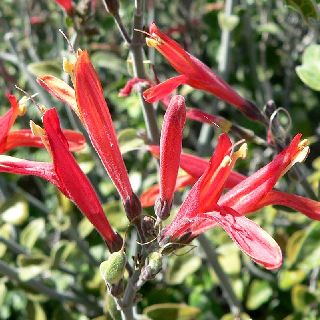
Chuparosa (Justicia californica) is a Sonoran Desert native that blooms on and off throughout the year.
There’s a reason the name means “hummingbird” in Spanish. If you want to attract hummingbirds into your yard, chuparosa is a “must have” shrub.
Rufous hummingbirds that migrate from Mexico to Alaska follow the chuparosa’s bloom path as they travel through the desert southwest.
Desert Marigold
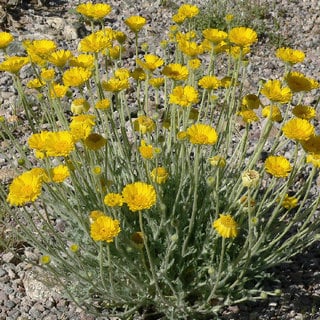
Desert marigold (Baileya multiradiata) may be the perfect wildflower for hot, dry gardens. It’s native to all three US deserts — Mojave, Sonoran, and Chihuahuan. This cheerful perennial blooms all year long and is virtually maintenance-free.
Once established in your yard, desert marigolds manageably reseed. I love that the new plants always seem to pop up in the perfect spots in my garden.
Feathery Cassia
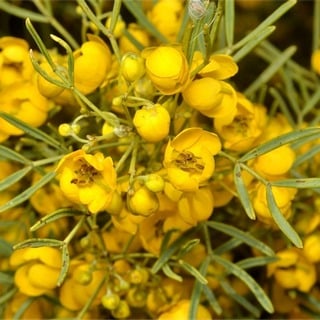
Feathery cassia (Senna artemisioides) is one of the first shrubs to flower in the winter. When this large evergreen shrub is bloom, it’s smothered with masses of fragrant, pea-shaped yellow flowers.
This native of Australia comes in several forms, so it can have flat, sickle-shaped leaves or fine, needle-like foliage in either silver or green. (I’m partial to the silver-leaf form, which shimmers in the right light.)
Firesticks
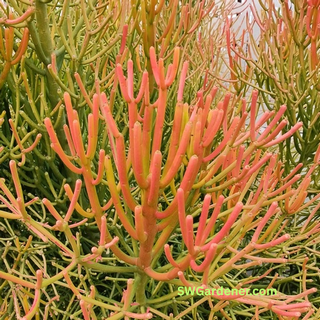
Firesticks (Euphorbia tirucalli ‘Sticks on Fire’) is a particularly colorful succulent that almost looks like it’s on fire.
This plant consists mostly of photosynthetic stems, which are normally green, thin, and pencil-like. But during the winter, these stems turn brilliant orange and red.
Firesticks are cold-sensitive below 28℉ and should either be covered or, if grown in a pot, moved to a protected spot during cold snaps.
Flowering Annuals
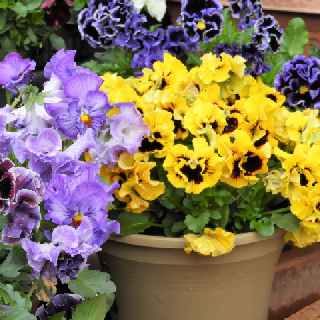
A visit to most nurseries in the fall will wow you with eye-popping spreads of colorful winter annuals, including snapdragons, alyssum, geranium, lobelia, stock, petunias, pansies, and violas.
You may have grown these annuals in the summer elsewhere, but here in “opposite world” they grow in the winter and die back in the hot summer. 🙃
Golden Barrel Cactus
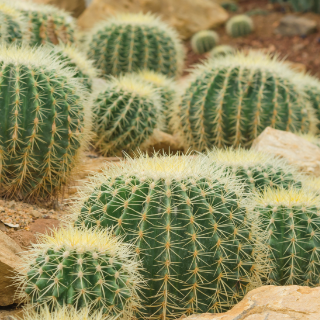
Golden barrel cactus (Echinocactus grusonii) is an iconic cactus that adds color and texture to any desert garden.
Unlike many cactus, golden barrel doesn’t have spectacular flowers. But it makes up for it with its symmetric rows of golden yellow spines that look particularly vibrant in the sun.
Gopher Plant
Gopher plant (Euphorbia rigida) is always an attractive, succulent-like ground cover. But in late winter, it becomes a show-stopper when its whorls of green-gray leaves are topped with chartreuse “hi viz” flowers so bright they almost glow.
Even when the flowers start to fade, they are lovely, turning into dusty pink clusters that look like mini-hydrangeas.

Heavenly Bamboo
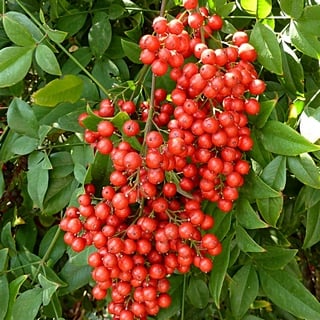
Heavenly bamboo (Nandina domestica) is a bamboo look-alike (not a true bamboo) that’s often grown for the year-round interest it provides to gardens.
White flowers in the spring are followed by red berries that persist through the winter. And when the temperature drops below 40°F, the foliage turns red or bronze.
Lilac Vine
Lilac vine (Hardenbergia violacea) is a lush evergreen vine native to Australia. In late winter, when most flowering desert vines are dormant, it explodes with showy purple flowers.
What a treat to see cascades of wisteria-like flowers in February!

Mexican Bird of Paradise
Mexican bird of paradise (Erythrostemon mexicanus) is a delightful, airy tree that stays green and flowers all year long.
This small tree may look lacy and delicate, but it’s a tough desert native that’s exceptionally heat tolerant and thrives in the hottest, sunniest spot in your garden — even in reflected heat along a west-facing wall.

Mexican Honeysuckle
Mexican honeysuckle (Justicia spicigera) is not a vine and it isn’t related to honeysuckles. It’s a medium size evergreen shrub with velvety green leaves and vivid orange flowers.
These plants bloom all year and their tubular flowers are hummingbird magnets. They are also larval hosts for several butterfly species.

Purple Hop Bush
Purple hop bush (Dodonaea viscosa ‘Purpurea’) is a fast-growing evergreen shrub that has bronzy-green leaves that turn reddish-purple when the weather gets cold.
It is grown in the garden mainly for its interesting foliage, rather than for its flowers, which are small and inconspicuous.

Purple hop bush is a cultivar of hop bush (Dodonaea viscosa), an evergreen shrub with emerald green leaves, a color often missing in the desert palette.
Santa Rita Prickly Pear
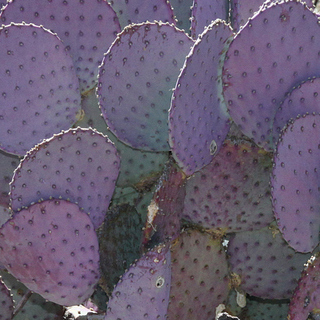
Santa Rita prickly pear (Opuntia ‘Santa Rita’) is a native cactus found in the Sonoran and Chihuahuan Deserts. It’s especially common in the foothills of Tucson’s Santa Rita Mountains.
This cactus has so many attractive features — purple pads, yellow flowers, and red fruit — it’s hard to believe it’s a native and not a nursery-bred hybrid!
Surprisingly, this cactus is at its most colorful in the winter. The blue-gray pads turn purple when stressed by cold.
Trailing Lantana
Trailing lantana (Lantana montevidensis) is an evergreen ground cover that’s blanketed with lavender flowers from spring through winter’s first freeze. It’s more cold-hardy than typical bush lantanas.
In mild winters, it will never stop blooming. When frost is expected, you can keep yours blooming by covering it when the temperature dips to the upper twenties.

Variegated Plants
Some plants bring color to the winter landscape with their variegated leaves. These are usually cultivars, varieties, or hybrids of the parent plant.
Here’s a picture of a spectacular potted variegated octopus agave (Agave vilmoriniana ‘Stained Glass’). Its yellow margins make this dramatic plant a standout.
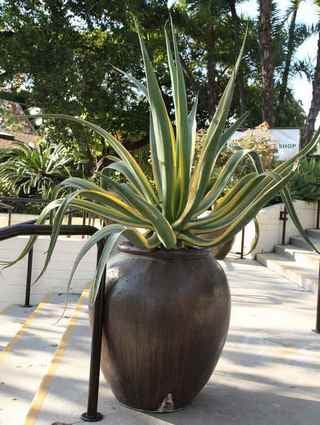
Here are some other desert landscape plants with colorful variegated cultivars:
- Baby sun rose (Aptenia cordifolia ‘Variegata’)
- Century plant (Agave americana var. marginata)
- Elephant food (Portulacaria afra ‘Variegata’)
- Indian hawthorn (Rhaphiolepis indica ‘Fiesta’)
- Skyflower (Duranta erecta ‘Variegata’)
- Smooth agave (Agave desmetiana ‘Variegata’)
Wolfberry
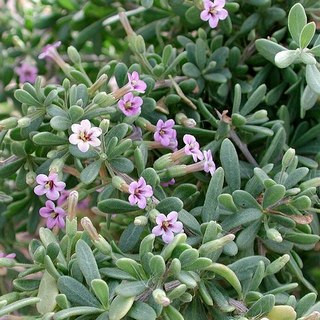
Wolfberry (Lycium fremontii) is a large shrub with semi-succulent gray-green leaves and adorable lavender flowers that bloom in late winter.
If you’re looking for a Sonoran Desert native that provides food for you and supports wildlife, you won’t find a better plant than wolfberry.
Its flowers provide nectar to bees, butterflies, and hummingbirds. Additionally, it’s a host plant for many species of moths and butterflies, including queens and monarchs.
Winter Color Roundup
So now you’ve got a good selection of colorful winter plants to choose from.
To learn more about any of these plants, click on the bold link of that plant’s name to find a comprehensive “plant profile.” It will tell you everything you need to know about successfully growing that plant.
And of course, there are many other ways to add color to your garden that don’t involve living plants. Colorful pottery, patio furniture, umbrellas, artwork, bird feeders, gazing balls, boulders, painted gates, and murals are just some of the many ways desert gardens can be brought to life with color.
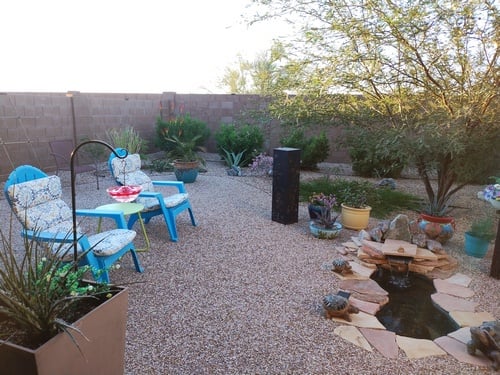
Here’s a spot in my backyard where I’ve added color with some of these features.
Have fun designing your colorful winter garden!
Did you enjoy this article?
Sign up for our weekly newsletter
where you’ll find more great info on creating &
maintaining a beautiful, carefree desert landscape.
Author Bio
Deane Alban is the creator of Southwest Gardener. She is a science writer with a bachelor’s degree in botany from the University of South Florida. Gardening is her lifelong passion. She’s been gardening in Tucson for over 15 years.

Photo Credits
Stan Shebs, CC BY-SA 3.0, Wikimedia Commons
Stan Shebs, CC BY-SA 3.0, Wikimedia Commons
Vengolis, CC BY-SA 4.0, Wikimedia Commons
Stan Shebs, CC BY-SA 3.0, via Wikimedia Commons
Stan Shebs, CC BY-SA 3.0, Wikimedia Commons
Arizona State University’s Virtual Library of Phoenix Landscape Plants
Arizona State University’s Virtual Library of Phoenix Landscape Plants
Krzysztof Ziarnek, CC BY 4.0, via Wikimedia Commons
The University of Arizona Campus Arboretum
Alan Schmierer, CC0, Wikimedia Commons
Mike, CC BY-SA 4.0, via Wikimedia Commons