
Are you looking for ways to save money on plants while still having the desert garden of your dreams? There are a surprising number of ways to acquire new plants at very reasonable prices or even for free. Learn the tips and tricks for expanding your garden on a budget here.
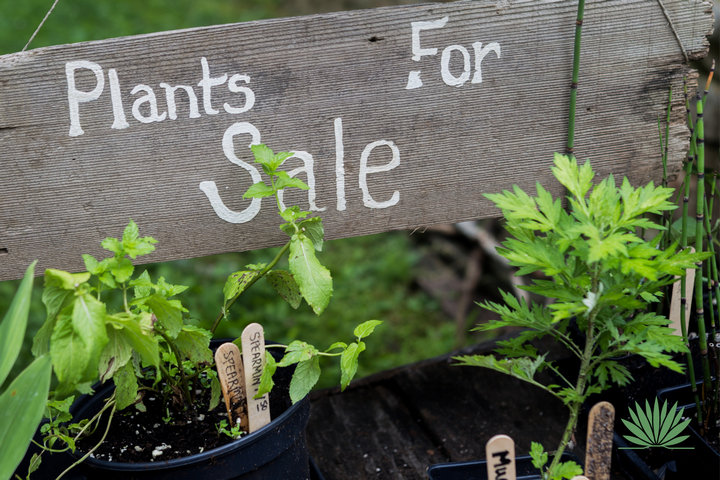
While I love all the plants in my desert garden, the ones I appreciate the most are the ones that I rescued, propagated, or otherwise acquired for free. I’m also partial to plants that turned out to be exceptional values for what I paid for them.
Whether you are on a budget, or simply enjoy the satisfaction that comes from rescuing or propagating a plant, here are some ways to find or grow affordable desert landscape plants.
Find Free Plants
Most gardeners love sharing their plants, so it’s not hard to find freebies. One of my top sources for free plants has been from my nearby free plant stand.
In Arizona, visit the Arizona Garden Exchange Stands Facebook Group or check this interactive map to find a free plant stand near you. If you live elsewhere, do an online search for “free plant stands near me”.
Do you belong to an online gardening group? Gardeners frequently look to rehome plants or share seeds or cuttings on groups such as the Tucson Backyard Gardening Group.
If you live in a community with an active Facebook group, keep an eye out for people giving away free plants and cuttings. This is also a good way to connect with neighbors who are fellow gardeners. 😉
Next Door and Buy Nothing are other places to look if you don’t use Facebook.
If you live in Tucson, you’re probably familiar with its “Brush & Bulky” program. Twice per year, residents can put out anything they want to get rid of, and the city picks it up for free. Among the old mattresses and appliances will be piles of yard debris. It’s not unusual to see mounds of succulent cuttings, agave and aloe pups, containers, and other gardening treasures there for the taking.
Find Bargains at Nurseries
It’s possible to find bargains at big box stores and nurseries. Some local nurseries have seasonal sales. Civano Nursery recently had a month long 50% off sale on all plants. Some have a specal give aways. For example, Four Arrows Nursery in Vail, AZ, regularly hosts “Free Succulent Saturday” events.
You’ve probably seen the “Half Dead, Half Off” clearance racks at garden centers. Some gardeners enjoy the challenge of bringing these plants back to life, while others use these plants as a source of seeds or cuttings.
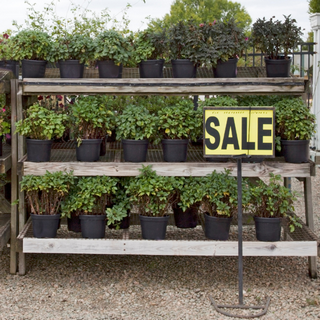
I’ve learned from enterprising gardeners that if you ask, you can sometimes negotiate an even better price. (I never would have thought of that!)
One of the most basic ways to get a “deal” is to start small. If a plant comes in a choice of sizes, always buy the smallest, least expensive size. Small plants are easier to plant (smaller hole to dig) and often catch up quickly, especially if you are buying a plant that is known to grow fast.
Another trick is to look for pots that contain more than one plant. When you get home, you can separate them for your own DIY “Buy One, Get One Free” sale. (And unlike the controversial practice of proplifting, it’s perfectly legit.)
No More FOMO!
Check out the Tucson Events Calendar
for upcoming plant sales.
Find Bargains in Unexpected Places
It’s common for gardeners to propagate plants and sell them as a sideline. I’ve found these ad hoc plant sales on Facebook, from street signs, or at flea markets or farmers’ markets. The prices on these plants are usually a fraction of retail prices.
Sometimes you can find great deals at stores that are known for selling things other than plants. I’ve seen some great deals at Sprouts, Trader Joe’s, Costco, Fry’s, and even Walgreens.
Tucson Cactus and Succulent Society rescues plants from construction sites, including saguaros, ocotillos, and other succulents that might normally be outside your budget. A few times a year, they sell these rescued plants to the public, depending on availability.
If you live in Tucson, you can find bargain-priced trees from TEP (Tucson Electric Power). Through their Trees for You Program, you can purchase 5-gallon trees for $5 every spring and fall.
If you live elsewhere, check to see if your electric company has a similar offer.
Try Your Hand at Propagation
You don’t always need to find free or bargain plants. Most plants can be propagated from cuttings or by dividing existing plants, so all you need is part of the plant. These can be from your own plants or from pieces that others have given you.
Propagating can be as easy or complex as you’d like. Many plants can be propagated by simply placing a cutting in water or potting mix, while more advanced methods include air-layering or grafting.
Propagating cactus and other succulents is generally pretty foolproof, and is a great way to save money since they can be expensive.
One of my favorite plants that I got for free is an octopus agave. A neighbor had left a box of offsets on the curb. It’s now a huge beauty that would have cost me beaucoup bucks if I’d bought it at a nursery.
Grow Plants from Seeds
Starting plants from seeds is obviously one of the most cost-effective ways to grow new plants. You might think that all you can grow from seeds are flowers and vegetables, but you can grow just about anything from seed.
Native Seeds/SEARCH is a not-for-profit organization that specializes in seeds for native edibles and wildflowers. You can also buy their seeds at Spadefoot Nursery in Tucson.
If you’re feeling more ambitious, check out the seed selections at Borderlands Nursery & Seeds or Phoenix Desert Seeds. You’ll find seeds for trees, shrubs, native grasses, vines, wildflowers, and succulents.
Recommended Reading:
The Easy Way to Grow Desert Wildflowers
Sources of Free Seeds
What could be more cost-effective than growing plants from seeds? Growing plants from free seeds.
If you live in Tucson, the Pima County library system has a free seed library for cardholders. You can check their seed selection online and place a hold, just like you do for books. While they carry mostly vegetable seeds, they also carry seeds for wildflowers and a few native shrubs.
If you live in Phoenix, Maricopa Community Colleges also operates a native seed library that carries seeds for a wide range of annuals, perennials, shrubs, and trees.
Check with your local library system to see if they have a seed library. Many do.
Of course, you can harvest your own seeds. Before harvesting seeds anywhere other than your own garden, please see A Guide to Collecting and Growing Sonoran Desert Wildflowers for information on how to harvest seeds responsibly.
Encourage Volunteers
Some of the happiest plants in my garden are volunteers — those that just popped, distributed by wind or animals.
Volunteers usually thrive because they’re growing in their preferred environment. (If the spot wasn’t suitable, the seed wouldn’t have sprouted.) Volunteers can be annuals, perennials, shrubs, succulents, or even trees.
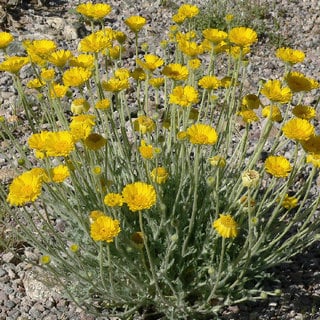
You can encourage the presence of volunteers by growing plants that are known to reseed. My favorite reseeder is desert marigold. This native perennial has cheerful yellow flowers 12 months a year and reseeds manageably — somehow always in the perfect spot.
Other desert landscape plants that reliably reseed include penstemon, brittlebush, Arizona poppy, desert bluebells, chocolate flower, desert senna, Superstition mallow, globe mallow, gopher plant, and sacred datura.
If you’re hoping for volunteers, learn to identify the seedlings, so you don’t pull them along with the weeds. I’ve never found one ultimate online source for identifying seedlings, but you can find images of some common seedlings here, here, and here.
Want volunteers?
Skip using pre-emergent.
It prevents seeds from germinating,
including those you want.
Grow Plants That Fill Space
Some plants take a lot of room, giving you a big bang for your gardening buck. One large, fast-growing shrub or vine can fill a space quickly for a relatively small investment.
A few plants that get big fast include red bird of paradise, brittlebush, yellow bells, Texas ranger, bougainvillea, yellow orchid vine, Queen’s wreath, and tangerine crossvine.
Some ground covers spread widely and cover a lot of ground, but without height. These are great for growing under trees or anywhere you want to break up expanses of gravel, add color and texture, or keep the ground cool for surrounding plants.
Ground covers that have exceeded my expectations include trailing lantana, outback sunrise emu, and myoporum. All cover large areas, and do so beautifully. And all cost under $10. When I found a 6 pack of myoporum for $8.00, I was over the moon since each plant easily grows to be 6 feet across or larger.
I hope these suggestions help you stock your garden with plants that bring you joy… at prices you love!
Did you enjoy this article?
Sign up for our weekly newsletter
where you’ll find more great info on creating &
maintaining a beautiful, carefree desert landscape.
Author Bio
Deane Alban is the creator of Southwest Gardener. She is a science writer with a bachelor’s degree in botany from the University of South Florida. Gardening is her lifelong passion. She’s been gardening in Tucson for over 15 years.

Photo Credit
Stan Shebs, CC BY-SA 3.0, Wikimedia Commons