
Lavender is a widely beloved perennial that can be challenging to grow in the desert. If you miss the fragrance of fresh lavender, consider growing desert lavender instead. Here’s how to grow this native of the Sonoran and Mojave Deserts.
The fresh, herbal fragrance of lavender is universally loved. But growing lavender in the desert is not always easy. So when you hear that there’s a lavender native to the southwest, you may want to give it a try.
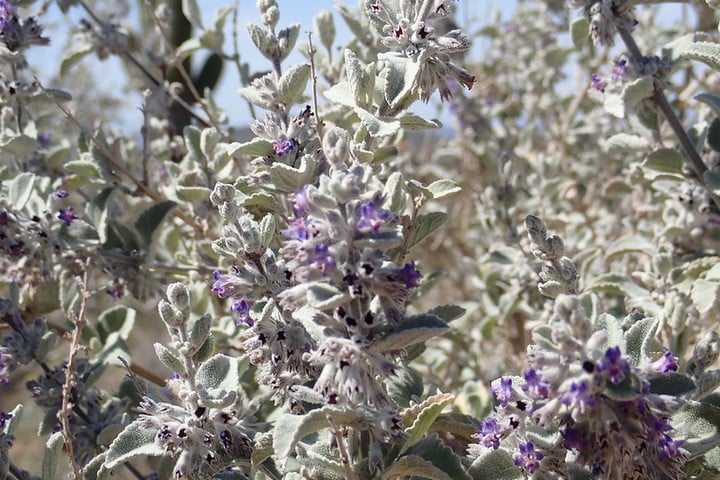
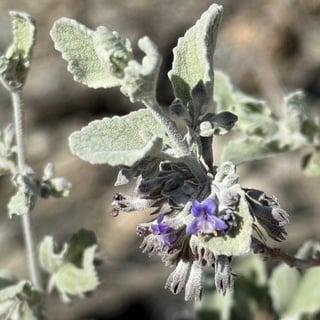
Desert lavender (Condea emoryi) has light purple flowers that smell like lavender. The woolly silver leaves emit a pleasant aroma when crushed or brushed against. And like creosote, desert lavender releases its scent when it rains.
This fragrant plant is not a true lavender (true lavenders belong to the genus Lavandula), but it is botanically related. Desert lavender and true lavenders all belong to the famously aromatic mint family (Lamiaceae).
And it isn’t exactly a substitute for lavender for one “big” reason — it’s a tall shrub that can grow to 10 feet tall!
But it’s still a wonderful alternative to “lavender” to consider for your garden for many reasons.
Unlike true lavender, which is temperamental in the southwest, desert lavender is not at all fussy. Since it’s a desert native, this plant can tolerate desert full sun, heat, and aridity. In its native habitat, it can survive on less than 3″ of rain per year.
Bees, butterflies, and hummingbirds love it. Since desert lavender blooms on and off throughout the year, it provides nectar when there isn’t much else available. It’s also a larval host for the gray hairstreak butterfly.
Why I Like This Plant
- Aromatic leaves and flowers
- Blooms much of the year
- Low maintenance, not fussy
- No thorns, low litter
- Supports pollinators
Things to Watch Out For
Desert lavender is semi-deciduous, meaning it loses its leaves when facing drought, extreme heat or cold, so it is sometimes leafless.
It is an informal rather than manicured-looking plant, so don’t plant this if you want a shrub you can keep pruned into a particular shape.
Optimal Growing Conditions
If you’re thinking of adding desert lavender to your garden, you need to find a suitable place that will keep your plant healthy and looking good… while minimizing maintenance for you.
Here are the key factors to keep in mind.
Temperature
Desert lavender should be grown in USDA Hardiness Zones 8 to 10. It’s a heat-loving plant that tolerates cold down to the low 20s.
It may drop some of its leaves during the winter. If it freezes back, it should rebound in the spring.
Sun Exposure
As a desert native, desert lavender likes full sun and doesn’t mind the reflected sun off garden walls and buildings. Sun encourages dense growth. Plants grown in part shade will be leggy and have fewer flowers.
Size and Growth Rate
Desert lavender grows moderately fast. Plants typically reach a size of 8 to 10 feet tall by 6 to 8 feet wide. But its size and growth rate depend largely on how much water it receives and how much it dies back in the winter.
Plants bloom most heavily in the spring, but often flower on and off throughout the year.
Soil
Desert lavender is not particular and will grow in any type of soil — rocky, sandy, or gravelly — provided it’s well-draining.
In its native habitat, it grows in sandy soil along rocky slopes, washes, and canyons, and it may struggle when grown in heavy clay.
Other Location Considerations
Since it is non-toxic, has no thorns, and is low-litter, it’s a plant you can place near a sidewalk, driveway, or patio, or anywhere else it might come in contact with people or pets.
Desert Lavender:
The Essentials
| Common Name | Desert lavender |
| Scientific Name | Condea emoryi |
| Origin | Sonoran, Mojave Deserts |
| Plant Type | Semi-deciduous shrub |
| USDA Zones | Zones 8 – 10 |
| Cold Hardiness | To 20℉ |
| Flower Color | Lavender |
| Flower Season | Throughout the year |
| Mature Size | 8-10’ high x 6-8’ wide |
| Growth Rate | Moderate to fast |
| Sun Tolerance | Full, reflected sun |
| Water Needs | Low |
| Pests & Diseases | None |
| Garden Friendly | No thorns, low litter, non-toxic |
| Wildlife | Attracts butterflies, bees, hummingbirds |
How to Plant
The rule of thumb when planting any shrub in the desert is to dig a hole three times as wide as the root ball but no deeper.
Amending the soil is not recommended. Counterintuitively, backfilling with the same native soil you just dug up helps your desert lavender develop a stronger root system.
However, if you know your soil is not well-draining or you have clay, consider amending it with coarse sand or small gravel.
When to Plant
The best time to plant desert lavender is in the fall. This gives it three seasons to grow roots and get established before the following summer.
The second best time is in spring, the earlier the better. This still gives your shrub time to get established before the intense heat of June arrives.
How to Care for Desert Lavender
Whether you’ve recently planted a desert lavender or have an existing plant in your yard, here’s how to take care of it to keep it healthy and looking its best.
How to Water New Plants
Once you’ve got your desert lavender in the ground, watering is your most immediate concern. Here is the recommended watering schedule for new shrubs planted in the spring or fall.
| Weeks 1 & 2 | Every 3 – 4 days |
| Weeks 3 & 4 | Every 5 – 7 days |
| Weeks 5 & 6 | Every 7 – 10 days |
| Weeks 7 & 8 | Every 10 – 14 days |
The first year, it’s recommended that you water it once a week during the summer (unless you’ve had rain). But after the first year, you can substantially cut back on watering.
How to Water Established Plants
After the first year, there are two watering factors to consider.
- First is how often to water. This will vary with the seasons.
- Second is how much water to give your shrub with each watering. This depends on the current size of your plant.
To determine the ideal watering schedule for desert lavender, you’ll find everything you need to know, including easy-to-use charts, at How to Water Desert Shrubs: How Often? How Much? Since it is a low water use plant, use the “Low Water Use” schedule.
Should You Fertilize?
There is no need to fertilize desert lavender. It has evolved to get all the nutrients it needs from the surrounding desert soil.
How to Prune
Desert lavender doesn’t need regular pruning. Remove any frost damage or lightly trim to shape or reduce legginess in the spring.
Plant Lover Facts
Desert lavender (Condea emoryi) is native to desert areas of Arizona, California, Nevada, and northwest Mexico.
You might still see this plant referred to by its previous scientific name, Hyptis emoryi.
Desert lavender has a long history of use. Flowers and leaves were made into a medicinal tea to treat colds and other illnesses.
Did you enjoy this article?
Sign up for our weekly newsletter
where you’ll find more great info on creating &
maintaining a beautiful, carefree desert landscape.
Author Bio
Deane Alban is the creator of Southwest Gardener. She is a science writer with a bachelor’s degree in botany from the University of South Florida. Gardening is her lifelong passion. She’s been gardening in Tucson for over 15 years.
