
Growing plants in the desert is already challenging, and growing them in clay soil can make it even more difficult. Learn how to tell if your soil is clay, the problems you might face, and the solutions. And learn why most popular fixes for clay soil are counterproductive in the desert southwest.
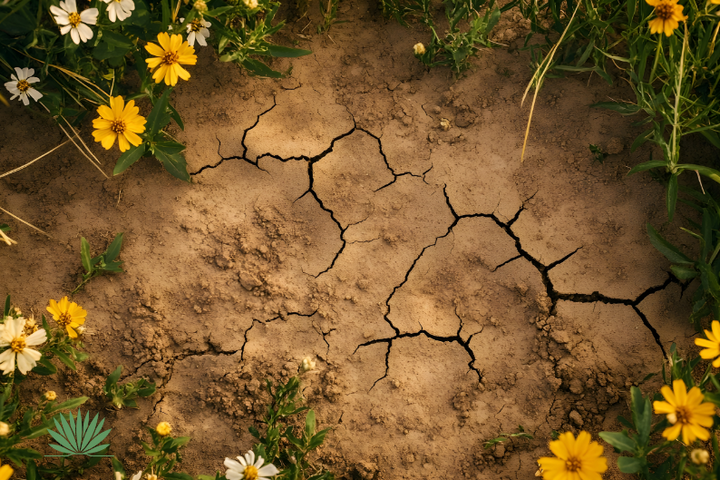
During my first 12 years in Tucson, my yards had sandy soil. I erroneously assumed that all desert soil was sand. So I was surprised when the soil at my current house turned out to be clay. What a difference!
The first time I stepped on my clay soil after a rain, I sank to my ankles. I thought I was stuck in quicksand! 😮
I quickly learned sand and clay are opposites in a few important ways:
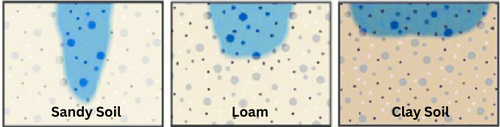
- Sand is made of large particles. It doesn’t hold water, drains well, and has excellent aeration.
- Clay is made of small particles. It holds water, drains poorly, and has poor aeration.
Here’s an illustration of how water moves through sandy, loam, and clay soils.
Clay Soil: Hard on Gardeners, Hard on Plants
Of all the soil types, clay has the smallest particles, less than 0.002 millimeters in diameter. This means the spaces between the particles are small as well.
Clay is notoriously hard to work with. When it’s wet, it’s sticky muck. When it’s dry, it turns into crusty hardpan that seems more like concrete than soil.
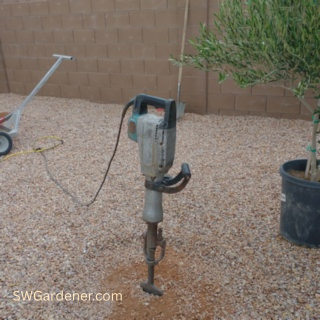
Digging holes is difficult and is best done in stages. You have to wet it, wait for the water to soak in, dig a little, and repeat.
My husband uses a chisel and hammer to get a hole started. The pros use a jackhammer.
Not all clay soil is alike. Your clay soil might not be the same as your neighbor’s — it might not even be the same throughout your yard.
The “clayiness” of soil exists on a continuum and there are various versions of clay soils — silty clay, sandy clay, clay loam, silty clay loam, and sandy clay loam, depending on the proportions of clay, sand, silt, and loam.
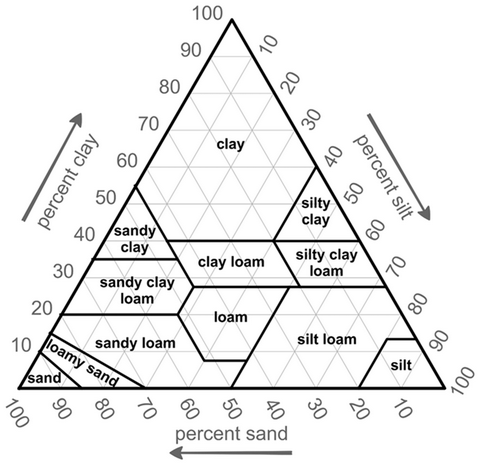
Loam, considered the “ideal” soil, is a mix of clay, silt, and sand.
Clay soil can be hard on your plants. The bulk of desert landscape plants prefer “well-draining soil” … and clay isn’t it.
Clay is easily compacted, stays wet, and has little room for air. This puts plants at risk for root rot due to lack of oxygen.
Just as clay soil is hard to penetrate with a shovel, it’s also difficult for plant roots to penetrate. When I see cracked, dry hardpan clay crust, I’m amazed that anything can survive in it.
Water has a hard time penetrating clay soil and tends to run off. This makes deep watering desert plants tricky.
Got Clay? How to Tell
You should suspect you have clay if your soil gets sticky when wet or turns into cracked hardpan when dry.
Here are a few other hints.
- Do your digging tools get covered with a thick layer that is hard to remove?
- Do your shoes get so coated that you look like Bigfoot?
- Do you see puddles in your yard that hang around after a rain?
If you answered yes to these, you almost certainly have clay.
But if you aren’t certain, here are a few easy tests you can perform to help you decide whether you have clay soil.
Squeeze Test
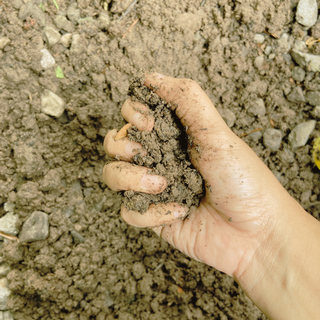
Moisten a small amount of soil and squeeze it in your hand. Clay soil feels sticky and will form a ball. (Sandy soil, feels gritty and doesn’t hold together.)
Percolation Test
Dig a hole approximately one foot deep and wide. Fill it with water and see how long it takes to drain. Sandy soil will drain in an hour or two, while clay soil will take four hours or more.
Jar Test
The jar test makes a fun science project for kids of all ages.
- Fill a jar halfway with soil, top with water, and shake.
- Let it settle for 24 hours.
- Layers will form, with sand at the bottom, silt in the middle, and clay on top.
Clay Soil Maps
Clay soil shrinks when dry and expands when wet, causing considerable damage to homes, sidewalks, pipelines, and streets.
Consequently, the University of Arizona created maps of the “shrink-swell potential” (i.e., clay) for both the greater Tucson and greater Phoenix areas. You can check out these maps to see if you live in an area that has clay soil.
If you live elsewhere, you can do an online search for “clay soil maps” to see if a similar map exists for your area.
How to “Fix” Clay Soil
If you have clay, you can’t magically turn it into loam, but there few ways you can improve it to increase particle size, make it more permeable to air and water, and less compacted.
Add Gravel
The next time you dig a planting hole, mix gravel in with the native soil you just dug up. This is a quick fix that instantly improves drainage and provides air pockets for better aeration.
Important Reminder!
Avoid walking on wet clay — it contributes to soil compaction.
Add Organic Matter
Like gravel, organic matter can help improve drainage and aeration. But unlike gravel, it will actually improve the long-term health of your soil.
Compost
The addition of compost increases the pore space in clay soil. This makes it easier to dig, and improves aeration and drainage.
Plant roots get more air and are less susceptible to root rot. They can more easily work their way through the soil and absorb nutrients.
Compost feeds your soil’s microbiome. Amazingly, a single teaspoon of healthy soil contains millions of bacteria, hundreds of thousands of fungi, thousands of protozoa, plus many larger organisms that break down organic matter and improve the soil.
Note, it’s recommended that you top dress your plants with compost rather than adding it to planting holes. If you amend the holes, the roots have no incentive to spread beyond that cushy environment. This can lead to stunted growth and girdled roots.
Grow More Plants
The presence of any plant can help improve clay. As the roots grow, they create spaces for air and water. As leaves, flowers, and seeds drop, they add organic matter to the soil.
But some plants are particularly good at breaking up clay, due to their robust root systems. Some, like artichokes, root vegetables, and cow peas, are great for veggie gardens, but might not fit in with your landscaping aesthetic. 😉
Plants that break up clay soil and won’t look out of place in the landscape include:
These plants can all easily be grown from seed. Growing wildflowers is an economical way to add beauty to your garden, support pollinators, and break up clay.
Leave Yard Debris
Instead of raking or blowing your yard, leave yard debris where it falls. It will break down and add organic matter to your soil.
Sometimes you may have to remove your leaves. Your HOA may require it, or you may have a copious amount of leaves from deciduous trees. In that case, you have a few options.
You can move the yard debris to a place where it’s not obvious, such as under shrubs, perennials, and groundcovers. You can move it from your front yard to your backyard. Or you can compost it and add it back to the soil later.
“Fixes” That Don’t Work in the Desert
Most of the information available regarding fixing clay is not appropriate for the desert southwest. It’s meant for places with different soils and climates. (Just another way that gardening is different here.)
Here are some of those ways and why they won’t work in desert clay.
Gypsum
The most common recommendation you’ll come across is to add gypsum (calcium sulfate). Proponents of gypsum claim it will change your soil’s particle size, loosen compaction, and improve drainage.
While it does work in some heavy clay soils and coastal regions with sodic (saline) soil, it doesn’t help the soils of the desert southwest.
According to a Pima County Master Gardener class on gypsum, it does not improve soil fertility, does not change the soil’s pH, and has no effect on soil drainage here.
You might be tempted to add gypsum anyway, thinking that it can’t do any harm and that it might be helpful. But adding gypsum is not harmless.
It increases leaching of iron and manganese in desert soils, potentially leading to deficiencies. And it has a negative impact on mycorrhizae, a beneficial relationship between fungus and plant roots.
Lime
Another common amendment often suggested is lime. But adding lime to desert soil is a complete waste.
Lime is a crushed rock that’s typically used to raise pH (make the soil more alkaline) and add calcium. But our soil is already very alkaline and loaded with calcium.
Lime is made of calcium carbonate — the same stuff that caliche, the bane of desert gardeners, is made of!
Sand
Sand is often recommended to amend clay soil since it has a large particle size and theoretically makes pockets for air and water. But when wet, sand and clay turn into a heavy mixture similar to concrete. Use gravel instead, which won’t have the same effect.
Desert Clay Soil: It’s Not All Bad
Clay soil is not all bad. Virtually all desert soils are either sandy or clay. Each has its pros and cons.
Compared to sandy soil, clay holds water, so you don’t have to water as often. And clay soil is high in nutrients.
Most desert plants tolerate clay. A few prefer it, and some struggle in it.
If you want to know whether a particular plant will grow in clay, see our Desert Plant Library. You’ll find comprehensive plant profiles, including their soil preferences, of over 200 popular desert landscape plants.
Did you enjoy this article?
Sign up for our weekly newsletter
where you’ll find more great info on creating &
maintaining a beautiful, carefree desert landscape.
Author Bio
Deane Alban is the creator of Southwest Gardener. She is a science writer with a bachelor’s degree in botany from the University of South Florida. Gardening is her lifelong passion. She’s been gardening in Tucson for over 15 years.
