
Sunny yellow trumpet-shaped flowers and emerald green leaves make Carolina jessamine an eye-catching vine. It’s native to the Southeastern US, but grows well in the desert. But before you plant one, be aware that all parts are highly toxic. Here’s how to plant and care for this evergreen vine.

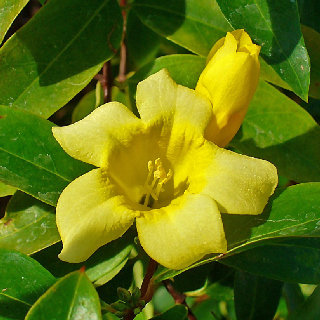
Carolina jessamine (Gelsemium sempervirens) is a colorful, evergreen subtropical vine. Its glossy emerald-green leaves turn bronze in cold weather. Its fragrant, trumpet-shaped flowers are lemon-yellow. Its wiry, twining stems are red-brown.
Unlike many heat-loving, flowering vines, it’s well-mannered and doesn’t need a lot of pruning to keep it from outgrowing its space.
It blooms from late winter to spring, providing bees, butterflies, and hummingbirds with nectar when few sources are available. Deer and rabbits generally leave it alone.
Why I Like This Plant
- Evergreen emerald leaves
- Sunny yellow flowers
- Well-behaved, minimal pruning
- Low maintenance, low litter
- Supports bees, butterflies, hummingbirds
Things to Watch Out For
Important warning! ⚠️ All parts of Carolina jessamine are extremely toxic and can be lethal to people, pets, livestock, and even to honeybees. (You’ll find more information on this plant’s toxicity at the end of this article.)
Some people experience dermatitis after handling the leaves, so wear gloves when working around this plant.
It is extremely flammable and should not be planted next to a fire pit or outdoor cooking area.
Optimal Growing Conditions
If you’re thinking of adding a Carolina jessamine to your garden, you need to find a suitable place that will keep it healthy and looking good… while minimizing maintenance for you.
Here are the key factors to keep in mind.
Temperature
Carolina jessamine should be grown in USDA Hardiness Zones 6 – 11. It thrives in a wide range of temperatures. It doesn’t mind the extreme heat of Phoenix in the summer, and is cold hardy down to 10℉. It’s evergreen, but the foliage turns bronze during extreme cold.
Sun Exposure
Carolina jessamine can be grown in full sun to light shade, but it blooms most profusely in full sun. Plants can struggle when grown along a west-facing wall, the hottest spot in the garden.
Size and Growth Rate
Carolina jessamine is a fast-growing, medium size vine that typically reaches a size of 10 to 15 feet high and wide. A plant’s mature size depends on how happy it is in its space, and how it’s watered and pruned.
Soil
Carolina jessamine prefers moist, rich soil high in organic matter. In its natural habitat, it’s found climbing trees in subtropical forests and woodlands.
But it’s tolerant of desert soil, provided it’s well-draining.
Other Location Considerations
Carolina jessamine is a twining vine that readily grows up any nearby support structure, such as a trellis, lattice, or fence, to form an evergreen screen.
If left unsupported, it can be grown as an informal, sprawling ground cover on banks and slopes.
If you don’t have room for a vine of this size, you can grow one in a large container provided you give it something to climb. Growing it in a pot slows its growth and limits its mature size.
⚠️ Important warning! ⚠️
All parts of Carolina jessamine are extremely toxic.
Ingestion can be lethal to people, pets, livestock, and possibly honeybees.
Carolina Jessamine:
The Essentials
| Common Name | Carolina jessamine |
| Scientific Name | Gelsemium sempervirens |
| Origin | Southeastern US to Central America |
| Plant Type | Evergreen vine |
| USDA Zones | Zones 6 – 10 |
| Cold Hardiness | To 10℉ |
| Flower Color | Yellow |
| Flower Season | Winter, spring |
| Mature Size | 10-15′ high x 10-15′ wide |
| Growth Rate | Fast |
| Sun Tolerance | Full, part sun |
| Water Needs | Moderate |
| Pests & Diseases | None |
| Cautions | Extremely toxic |
| Wildlife | Attracts hummingbirds, bees, butterflies |
How to Plant
The rule of thumb when planting any vine in the desert is to dig a hole three times as wide as the root ball but no deeper.
Since Carolina jessamine prefers moist, rich soil, consider amending your hole with compost or a commercial soil mix. Top with organic mulch rather than gravel, which helps to retain moisture and increase soil fertility.
When to Plant
The best time to plant Carolina jessamine is in the fall. This gives it three seasons to grow roots and get established before the following summer.
The second best time is in spring, the earlier the better. This still gives it time to get established before the intense heat of June arrives.
How to Care for Carolina Jessamine
Whether you’ve recently planted a Carolina jessamine or have an existing plant in your yard, here’s how to take care of it to keep it healthy and looking its best.
How to Water New Plants
Once you’ve got your Carolina jessamine in the ground, watering is your most immediate concern. Here’s a recommended watering schedule for new vines planted in the spring or fall.
| Weeks 1 & 2 | Every 3 – 4 days |
| Weeks 3 & 4 | Every 6 – 7 days |
| Weeks 5 & 6 | Every 7 – 10 days |
| Weeks 7 & 8 | Every 10 – 14 days |
After week 8, gradually revise your watering schedule, depending on the season.
How to Water Established Plants
Here’s a recommended watering schedule for subsequent years.
| Spring & Fall | Every 10 – 14 days |
| Summer | Every 7 – 10 days |
| Winter | Every 14 – 21 days |
Carolina jessamine prefers consistently moist soil but is somewhat drought tolerant once established.
Should You Fertilize?
Since Carolina jessamine is a prolific bloomer and not native to the desert, it benefits from an application of fertilizer in the spring.
How to Prune
Unlike some of the more vigorous vines (i.e., queen’s wreath and tangerine crossvine), Carolina jessamine grows manageably and needs minimal pruning.
To invigorate it, remove 1/3 of the canopy every year and give it a hard prune every few years. You can lightly prune it after it’s done blooming to shape or remove any dead or damaged branches.
Plant Lover Facts
Carolina jessamine (Gelsemium sempervirens) goes by many common names including yellow jessamine, confederate jessamine, Carolina jasmine, Carolina yellow jasmine, false jasmine, evening trumpetflower, and woodbine.
The genus name Gelsemium is a Latinized form of the Italian word for jasmine, gelsomino.
Despite its common name, it does not belong to the jasmine genus Jasminum and therefore is not a “true jasmine”.
Carolina jessamine’s native range encompasses the US southeast and runs south through Mexico to Honduras. It occurs as far west as Texas.
It’s the state flower of South Carolina.
More on Carolina Jessamine Toxicity
All parts of this vine contain the neurotoxic alkaloids gelsemine, gelsemicine, gelsedine, gelseverine, and gelseminine. These compounds make the entire plant highly toxic to people, pets, and livestock, including cattle, goats, horses, chickens, and geese. Children can be poisoned by sucking the nectar from the flowers.
There’s also a concern that its pollen can be toxic to non-native honeybees. It seems that in their native range, native bees are not affected.
But since desert gardeners would be growing this plant outside of its native range, would our native bees be immune, too? With up to 700 native bee species, the Sonoran Desert is one of the most bee-diverse spots in the world, so this is an important question yet to be answered.
If you want to learn more about Carolina jessamine’s potential risk to bees, here’s some suggested reading:
- Ask Mr. Smarty Pants (Lady Bird Johnson Wildflower Center)
- The Dirt (Pinellas Master Gardener Magazine)
- Tara Lynne Today (Beekeeping Substack)
Did you enjoy this article?
Sign up for our weekly newsletter
where you’ll find more great info on creating &
maintaining a beautiful, carefree desert landscape.
Author Bio
Deane Alban is the creator of Southwest Gardener. She is a science writer with a bachelor’s degree in botany from the University of South Florida. Gardening is her lifelong passion. She’s been gardening in Tucson for over 15 years.

Photo Credits
Kenpei, CC BY-SA 3.0, via Wikimedia Commons
H. Zell, CC BY-SA 4.0, via Wikimedia Commons