
If you’re looking for a large, dramatic succulent that also adds color to your garden, check out Cape aloe. This unusual aloe grows tall and puts out branched candelabras of vivid flowers every winter. Here’s how to grow this South African native as a desert landscape plant.
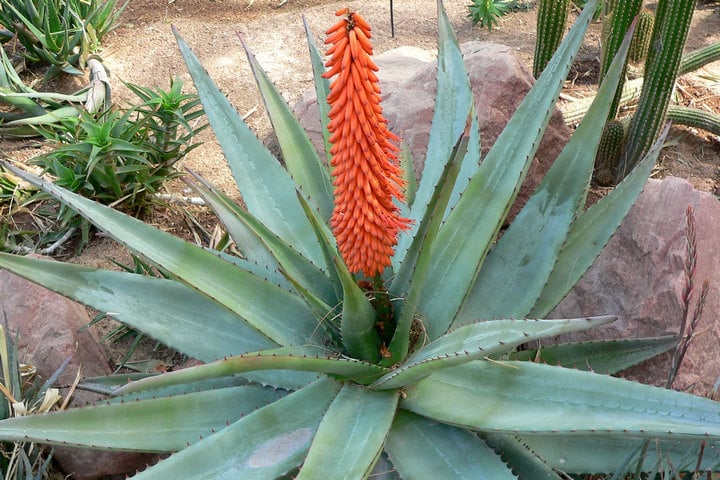
Most aloes grow as rosettes that are about as tall as they are wide, but a few grow tall and tree-like. Of all the tree aloes, Cape aloe (Aloe ferox) is the species most commonly grown as a southwest desert landscape plant.
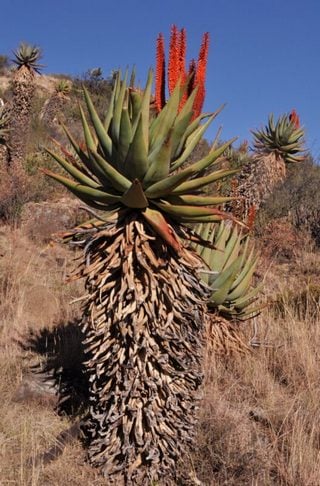
When young, its thick blue-green leaves form a symmetric rosette. At this stage, it looks like a typical aloe. But over time, it starts to look like a mutant palm tree that escaped from Jurassic Park!
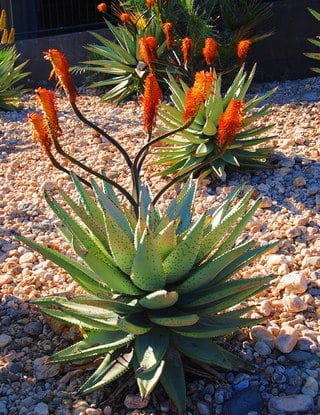
It grows tall (up to 10 feet!) and develops a single trunk. Leaves have weird, knobby spines. The number of flower stalks increases. Plants usually send up 4 to 8 stalks at a time, but can have even more.
Every winter, their wild-looking candelabra flower stalks add vivid color to winter gardens, and attract bees and hummingbirds. The tubular flowers are usually orange-red but can range from yellow-orange to bright red.
Why I Like This Plant
- Dramatic specimen plant
- Adds vivid winter color
- Low maintenance
- Attracts bees, hummingbirds
- Deer, rabbit, javelina resistant
Things to Watch Out For
If you’re used to growing aloes in containers, or you grow diminutive ‘Blue Elf’ aloe as a landscape plant, the size of Cape Aloe can come as a shock. It can ultimately reach 6 to 10 feet tall with 4 foot flower stalks.
Cape aloe is more prickly than many other aloes, too. It was given the name ferox (which means “fierce” or “warlike”) for a reason! This refers to its sharp edges and knobby spines that dot leaf surfaces.
Optimal Growing Conditions
If you’re thinking of adding a Cape aloe to your garden, you need to find a suitable place that will keep your plant healthy and looking good… while minimizing maintenance for you.
Here are the key factors to keep in mind.
Temperature
Cape aloe should be grown in USDA Hardiness Zones 9 – 11. It tolerates most summer heat, but struggles when the temperature exceeds 115℉. For this reason, it’s not commonly grown in hotter areas like Phoenix.
It can survive cold down to 20℉ but may experience damage when the temperature dips below 25℉.
Sun Exposure
Cape aloe can be grown in full to part sun. It appreciates relief from fierce afternoon sun during the hottest months.
Size and Growth Rate
Cape aloe can ultimately reach a mature size of 6 to 10 feet tall by 3 to 5 feet wide. When in bloom, flower stalks can add an extra 2 to 4 feet in height.
Soil
Cape aloe can be grown in any native desert soil, but it prefers sandy or rocky well-draining soil.
Other Location Considerations
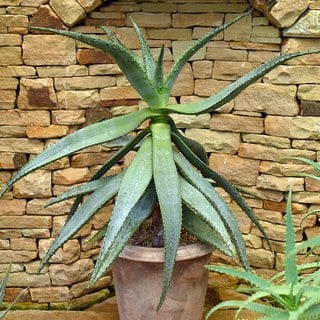
This is one large aloe! If space is a problem, consider growing one in a large container, which will keep its size in check. Make sure your pot has good drainage and use specifically formulated cactus soil.
Cape Aloe:
The Essentials
| Common Name | Cape aloe |
| Scientific Name | Aloe ferox |
| Origin | South Africa |
| Plant Type | Evergreen succulent |
| USDA Zones | Zones 9 – 11 |
| Cold Hardiness | To 20℉ |
| Flower Color | Orange-red |
| Flower Season | Winter |
| Mature Size | 6-10′ high x 3-5’ wide |
| Growth Rate | Slow |
| Sun Tolerance | Full, part sun |
| Water Needs | Low |
| Pests & Diseases | Root rot |
| Garden Friendly | No litter, non-toxic |
| Wildlife | Attracts bees, hummingbirds |
How to Plant
To plant a Cape aloe, dig a hole the same depth as the root system and twice as wide.
It’s generally recommended that you not add amendments to the soil. However, good drainage is critical, so if your soil drains slowly, amend with coarse sand or small gravel until you have a loose, well-drained mix.
When to Plant
Most landscape succulents (cactus, agave, etc.) should be planted in the spring, but winter-blooming aloes are an exception. They do most of their growing in the winter and establish best when planted in the fall.
How to Care for Cape Aloe
Whether you’ve recently planted a Cape aloe or have an existing plant in your yard, here’s how to take care of it to keep it healthy and looking its best.
How to Water
You’re probably used to giving a plant a good soaking immediately after transplanting, but that isn’t the best practice with aloes and other succulents. Counterintuitively, it’s best to not water aloes for one to two weeks after planting.
Then, water twice per month spring through fall. Always allow the soil to dry out between waterings.
No supplemental water is needed during the winter, provided there have been winter rains. And, as with all succulents, skip watering when freezing temperatures are expected.
Should You Fertilize?
There is no need to fertilize aloes growing in the ground. They get all they need from the surrounding desert soil. But if you grow one in a container, fertilize it lightly a few times a year when it’s actively growing.
Pruning
Cape aloe doesn’t need pruning, other than removing spent flower stalks.
You can remove old, dried leaves but you don’t have to. When left unpruned, they form a skirt, similar to palm trees. Many gardeners prefer this no-maintenance choice.
Plant Lover Facts
Cape aloe (Aloe ferox) also goes by the common names tree aloe, bitter aloe, tap aloe, and red aloe. It’s called “Cape” aloe because it’s native to the Cape regions of South Africa, where it can be found growing on rocky slopes, open scrublands, and grasslands.
Cape aloe has similar medicinal properties and uses to aloe vera and is important commercially. It’s sold as a supplement for treating constipation and arthritis, and is an ingredient in skin care products and shampoos.
The genus Aloe has over 500 species. When you see an aloe, you can know for sure it’s not native to the desert southwest, since all aloes are native to the eastern hemisphere.
Did you enjoy this article?
Sign up for our weekly newsletter
where you’ll find more great info on creating &
maintaining a beautiful, carefree desert landscape.
Author Bio
Deane Alban is the creator of Southwest Gardener. She is a science writer with a bachelor’s degree in botany from the University of South Florida. Gardening is her lifelong passion. She’s been gardening in Tucson for over 15 years.

Photo Credits
Stan Shebs, CC BY-SA 3.0, via Wikimedia Commons
Falcodigiada, CC BY-SA 4.0, via Wikimedia Commons
小石川人晃, CC BY-SA 4.0, via Wikimedia Commons