
Black-eyed Susan vine is a charming twining vine available in a rainbow assortment of colors. It can be grown as an annual or perennial, depending on your microclimate. It’s native to the tropics of Africa, but with the right care makes a reliable addition to desert southwest gardens.
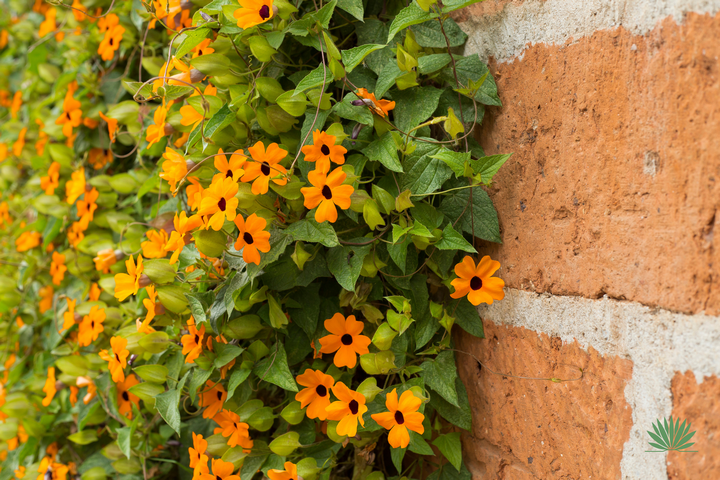
Black-eyed Susan vine (Thunbergia alata) has fuzzy, heart-shaped leaves and cheerful flowers that are typically orange or yellow, but come in many other colors.
Unlike many vines grown in the southwest, it does not grow aggressively and stays a manageable size with minimal trimming.
Depending on your hardiness zone, it may grow as either a frost-tender annual (Zones 2-9) or a short-lived perennial (Zones 10-11).
This plant gets its name from its flowers’ dark centers. It blooms from summer through the first frost, attracting bees, butterflies, and hummingbirds.
Why I Like This Plant
- Charming flowers in a variety of colors
- Grows fast but not rampantly
- Easy to start from seed
- Low maintenance
- Attracts bees, butterflies, hummingbirds
Things to Watch Out For
Black-eyed Susan vine is not terribly tolerant of the desert’s extreme conditions. It struggles in intense heat and sun. It’s not cold-hardy, which should not be a problem if you intend to grow it as an annual.
The leaves are covered with hairs that some people find irritating.
Optimal Growing Conditions
If you’re thinking of growing a black-eyed Susan vine in your garden, you need to find a suitable place that will keep it healthy and looking good… while minimizing maintenance for you.
Here are the key factors to keep in mind.
Temperature
Black-eyed Susan vine tolerates summer heat but struggles in the hottest places like Phoenix.
It can be grown as a short-lived perennial in USDA Hardiness Zones 10 – 11. When grown in Zone 9, it can survive the winter if protected when the temperature dips into the 20s.
Sun Exposure
Finding the “Goldilocks” spot for this plant can be tricky. Plants need about 6 hours of sun for maximum blooms, but prefer afternoon shade. Ideally, they should get full morning sun with part shade in the afternoon.
Size and Growth Rate
Black-eyed Susan vine is a fast-grower that will reach 6 to 8 feet high and 2 to 3 feet wide in one season if grown as an annual. If it doesn’t die back in the winter, it can reach 20 feet tall.
You can expect to see flowers from mid-summer through the first frost.
Soil
Black-eyed Susan vine prefers fertile, moist, well-draining soil. For this reason, you may want to plant it in an amended hole or grow it in a container.
Other Location Considerations
This twining vine readily grows up any nearby support structure, such as a trellis, lattice, or fence, to form a dense screen.
If left unsupported, it will form a sprawling ground cover. When planted in raised beds, it will cascade over the edges. I’ve seen this done, and the results are beautiful!
Plants do well in containers. They’ll climb when supported or spill over the sides if not.
Black-Eyed Susan Vine:
The Essentials
| Common Name | Black-eyed Susan vine |
| Scientific Name | Thunbergia alata |
| Origin | South Africa |
| Plant Type | Annual vine |
| USDA Zones | Zones 10 – 11 |
| Cold Hardiness | To 28℉ |
| Flower Color | Yellow to orange |
| Flower Season | Summer, fall |
| Mature Size | 6-8′ high x 2-3′ wide |
| Growth Rate | Fast |
| Sun Tolerance | Full, part sun |
| Water Needs | Moderate |
| Garden Friendly | No thorns, low litter, non-toxic |
| Caution | May cause dermatitis |
| Wildlife | Attracts butterflies, bees, hummingbirds |
Growing Black-Eyed Susan Vine: Seeds vs Transplants
You can grow black-eyed Susan vine from seed, or you can start with transplants. While plants aren’t common, you can occasionally find them at nurseries and big box stores with garden centers.
How to Start From Seed
Black-eyed Susan vine is easy to grow from seeds.
Plant directly in a sunny spot after the danger of frost has passed. Seeds germinate best when planted in warm soil. Soaking seeds overnight greatly improves their germination rate. You can expect to see sprouts within 2 to 3 weeks.
Seed Cultivars
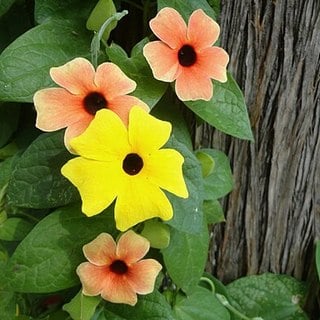
If you grow vines from seeds, there’s a wide array of flower color options. Besides the usual orange or golden-yellow flowers, you’ll find white, cream, pink, peach, apricot, red, lemon yellow, and more.
Can’t decide? Some seed packets contain a mix for a rainbow effect.
Once you grow one plant, it’s easy to collect seeds to grow next year. Seeds are roughly the size and color of peppercorns.
How to Plant Transplants
The rule of thumb when planting any vine in the desert is to dig a hole three times as wide as the root ball but no deeper.
Since black-eyed Susan vine prefers fertile soil, consider amending your hole with compost or a commercial soil mix, and top with organic mulch.
The best time to plant it is in the fall. This gives your vine three seasons to grow roots and get established before the following summer.
The second best time is in spring, the earlier the better. This still gives your plant time to get established before the intense heat of June arrives.
How to Care for Black-Eyed Susan Vine
Black-eyed Susan vine care requirements differ slightly depending on whether you are growing it as an annual or perennial.
Annual Care
If you are growing these vines as annuals, keeping them watered is your main task. Plants are not particularly drought tolerant and need a moderate amount of water to look their best.
Soil should be kept somewhat moist and not allowed to completely dry out. This is easier to accomplish if you put your plants on irrigation or plant with an olla or water stake, especially when grown in a container.
Fertilizing and pruning are not necessary, but you can trim any errant branches or pinch the ends to encourage bushiness, if you so desire.
Perennial Care
If you are growing it as a perennial, you may want to fertilize once in the spring to maximize blooms.
And if your plant was damaged by frost, give it a hard prune in the spring. If not, trim it lightly to shape and promote flowering.
Plant Lover Facts
Black-eyed Susan vine (Thunbergia alata) is native to tropical regions of Africa and Madagascar.
It has naturalized throughout South America, Southeast Asia, Central America, and Mexico. In the US, it’s escaped cultivation in Texas, Alabama, and Florida. It’s considered invasive in Hawaii and Australia.
In Africa, it is used medicinally and to feed livestock.
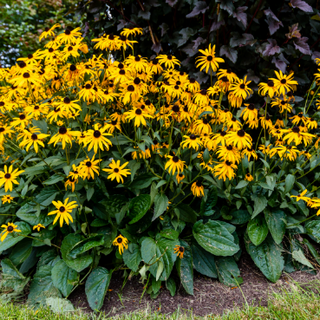
While both have gold flowers with dark brown center, black-eyed Susan vine is not botanically related to the popular perennial black-eyed Susan (Rudbeckia spp.).
While black-eyed Susan vine and the popular perennial black-eyed Susan (Rudbeckia spp.) both have gold flowers with dark brown centers, they are not botanically related.
Did you enjoy this article?
Sign up for our weekly newsletter
where you’ll find more great info on creating &
maintaining a beautiful, carefree desert landscape.
Author Bio
Deane Alban is the creator of Southwest Gardener. She is a science writer with a bachelor’s degree in botany from the University of South Florida. Gardening is her lifelong passion. She’s been gardening in Tucson for over 15 years.

Photo Credits
Juan Carlos Fonseca Mata, CC BY-SA 4.0, via Wikimedia Commons