
Banana yucca is a succulent that makes a bold accent plant in any garden. When in bloom, it has showy, yet delicately colored flowers. Here’s everything you need to know about planting and caring for this southwest desert native.
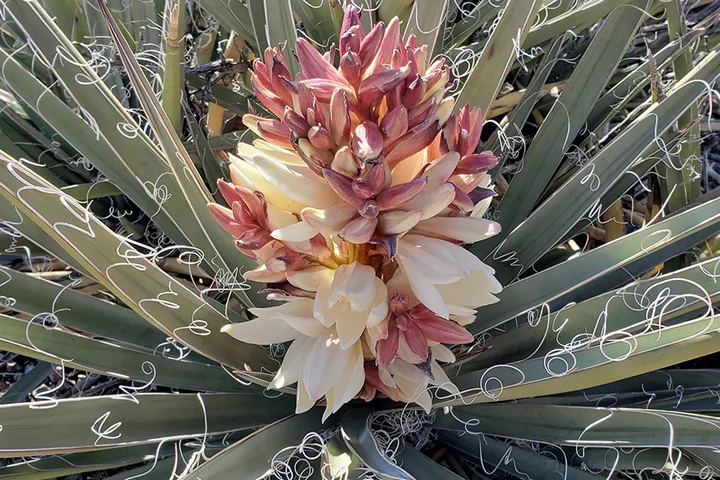
Banana yucca (Yucca baccata) makes a bold specimen plant. Its long, sword-like leaves are lined with curly white filaments along the margins.
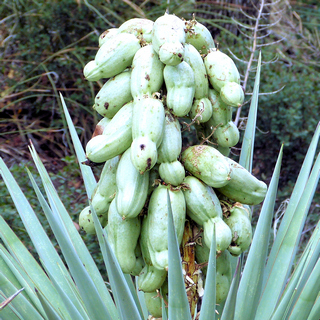
It doesn’t flower every year, but when it does, it’s stunning. Dusty rose colored buds unfold into clusters of large, creamy white, bell-shaped flowers. Flowers are sometimes followed by edible fruit that someone thought resembled bananas, hence the name “banana” yucca. (Short, fat, lumpy, green ones. 🙂)
Banana yucca is extremely low-maintenance and is one of the toughest natives you can plant. All it requires from you is that you occasionally give it water while it’s getting established. In its native habitat, it can survive on as little as 2″ of annual rainfall.
When in bloom, this plant is great for supporting wildlife. Its flowers attract moths, butterflies, bats, and insects. The fruit attracts birds and mammals large and small.
Why I Like This Plant
- Dramatic specimen plant
- Stunning flower stalks
- Looks good all year long
- Withstands extreme heat and cold
- Virtually maintenance-free
Things to Watch Out For
All yuccas contain saponins that are toxic to dogs, cats, and horses. (While some parts are edible, don’t consume any part of a yucca unless you know what you’re doing.)
Banana yucca leaves have sharp tips that can jab you, so handle with care.
Don’t grow this plant for the fruit since it only blooms every 3 to 5 years, and even in a flowering year, it doesn’t reliably produce. For banana yucca fruits to set, two things must happen. The right species of moth needs to show up. And it needs to be cross-pollinated with another banana yucca plant.
The fruit is edible only after cooking and is more vegetable-like than fruit-like. It’s described as tasting like a potato or sweet potato.
Optimal Growing Conditions
If you’re thinking of adding a banana yucca to your garden, you need to find a suitable place that will keep your plant healthy and looking good… while minimizing maintenance for you.
Here are the key factors to keep in mind.
Temperature
Banana yucca should be grown in USDA Hardiness Zones 5 – 11. It tolerates intense desert heat and is cold-hardy down to -20℉.
Sun Exposure
Banana yucca does best in full sun but will tolerate either part shade or the reflected heat off a hot wall or building.
Size and Growth Rate
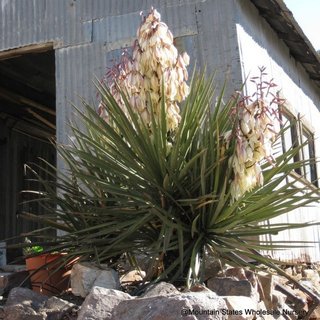
Banana yucca is a slow-growing plant that is wider than tall. It ultimately reaches a size of around 4 feet tall by 6 feet wide, but can grow larger.
The form of this plant can vary widely. Some plants have a single-trunk specimen, while others have multiple trunks.
When plants bloom, they send up 3 foot flower stalks.
Soil
Banana yucca prefers dry, alkaline, sandy, or rocky soil that is well-draining.
Other Location Considerations
If you have a challenging rocky slope, consider growing banana yucca. It can often be found growing on rocky slopes in the wild.
Banana Yucca:
The Essentials
| Common Name | Banana yucca |
| Scientific Name | Yucca baccata |
| Origin | Mojave, Sonoran, Chihuahuan Deserts |
| Plant Type | Succulent |
| USDA Zones | Zones 5 – 11 |
| Cold Hardiness | To -20℉ |
| Flower Color | Creamy white |
| Flower Season | Late spring, summer |
| Mature Size | 4′ high x 6’ wide |
| Growth Rate | Slow |
| Sun Tolerance | Full, reflected, part sun |
| Water Needs | Low |
| Pests & Diseases | None |
| Garden Friendly | Toxic to pets |
| Wildlife | Attracts polllinators |
How to Plant
To plant a banana yucca, dig a hole the same depth as the root system and twice as wide.
It’s generally recommended that you not add any soft fill, gravel, or fertilizer, just native soil.
However, good drainage is critical. If you know your soil is slow-draining, amend with coarse sand or small gravel until you have a loose, well-drained mix.
Carefully remove the plant from the container, put it in the hole, and press the soil to remove any air pockets.
When to Plant
The best time to plant banana yucca is April or May. Warm soil temperatures encourage root development.
How to Care for Banana Yucca
Whether you’ve recently planted a banana yucca or have an existing plant in your yard, here’s how to take care of it to keep it healthy and looking its best.
How to Water
You’re probably used to giving a plant a good soaking immediately after transplanting, but that isn’t the best practice with desert succulents like banana yucca.
Counterintuitively, it’s best not to water succulents for one to two weeks after planting. Then, water once per month spring through fall. No supplemental water is necessary during the winter.
Once banana yucca is established, it can survive on rainwater alone, but plants look better with some supplemental water, but no more than once a month.
Should You Fertilize?
There is no need to fertilize banana yucca, it will get all the nutrients it needs from desert soil.
Pruning & Propagation
Banana yucca should not be pruned other than removing lower leaves as they die. You can do this any time of year.
The only other pruning task you’ll want to do is to remove any spent flower stalks.
Banana yucca produces offsets, which you can prune and use to start new plants.
Plant Lover Facts
Banana yucca (Yucca baccata) also goes by the common names blue yucca, fleshy-fruited yucca, and datil.
It’s native to parts of the Sonoran, Mojave, and Chihuahuan Deserts. It can be found growing in Arizona, California, Colorado, Nevada, New Mexico, Texas, Utah, and parts of Mexico.
Banana yucca was an important plant to Native Americans, who discovered many uses for it. The flowers were eaten raw. The fruits were cooked to make beverages, preserves, sauces, syrups, and breads. The leaf fibers were used to make rope, baskets, and clothing. And the roots were used to make soap.
There are 53 yucca species and each one is pollinated by a single species of moth. The female moths pollinate the flowers and moth larvae feed on the developing fruit, forming a symbiotic relationship. Pretty amazing!
There are only three yuccas native to Pima County (Tucson), and banana yucca is one of them. The other two are soaptree yucca (Yucca elata) and Joshua tree (Yucca brevifolia).
Did you enjoy this article?
Sign up for our weekly newsletter
where you’ll find more great info on creating &
maintaining a beautiful, carefree desert landscape.
Author Bio
Deane Alban is the creator of Southwest Gardener. She is a science writer with a bachelor’s degree in botany from the University of South Florida. Gardening is her lifelong passion. She’s been gardening in Tucson for over 15 years.
