
If you’re looking for a low-maintenance desert vine that stays a manageable size, supports butterflies, and has exotic “other worldly” flowers, look no further than Arizona passionflower. Here’s how to grow this native of southern Arizona.
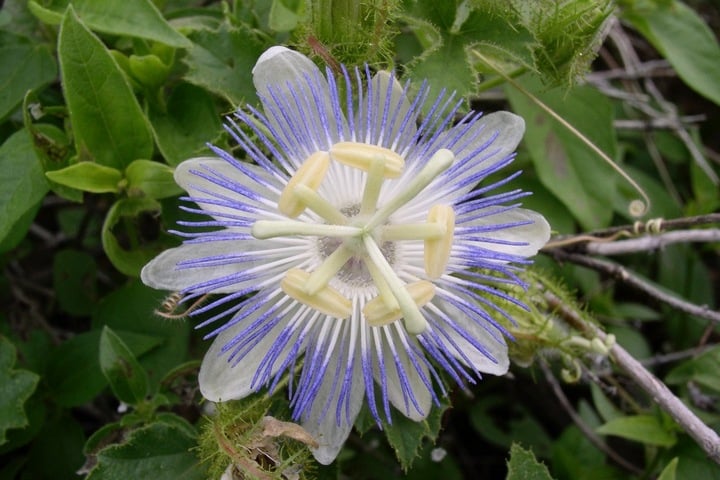
Arizona passionflower (Passiflora arizonica) looks like it belongs in the tropics, but this deciduous vine is native to southern Arizona.
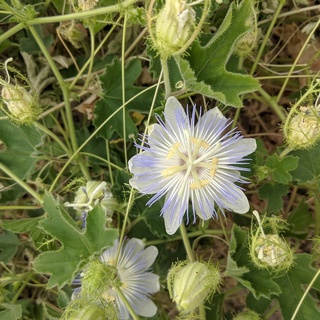
Spring through fall, it’s studded with elaborate, exotic-looking white and purple (or sometimes blue) flowers that are unlike anything else native to the desert.
Each flower blooms in the late afternoon and lasts for a day. Flowers are followed by small fruits that are technically edible, but not worth harvesting.
Since it’s native, it thrives in desert gardens. And, unlike many landscape vines which grow rampantly, it stays a manageable size (around 10 feet) and does not need extensive pruning.
This night bloomer is pollinated by moths and is a larval host for the beautiful gulf fritillary butterfly.
Why I Like This Plant
- Exotic white and purple/blue flowers
- Tough desert native
- Grows fast but stays a manageable size
- Does not need fertilizer (for a surprising reason!)
- Supports moths, butterflies
Things to Watch Out For
All parts of Arizona passionflower contain cyanide and are toxic, except for the ripe fruit.
If you want a passionflower vine with huge flowers, this is not the species you’re looking for. This vine’s 2 inch flowers are not as large as those of the more commonly grown passionflower vines.
Since it is a larval host for butterflies, you can expect to see caterpillars eating the leaves. Supporting butterflies is one of the main reasons to grow this. If caterpillar damage does not fit with your gardening aesthetics, you should take a pass on this plant.
The flowers are fragrant, but the leaves smell bad when crushed.
This perennial vine is relatively short-lived, lasting only 5 to 7 years.
Arizona passionflower can be hard to find. Your best chance of finding one is at any nursery that specializes in native plants. (Here in Tucson, I’d recommend checking with Spadefoot Nursery. They occasionally have them in stock.)
Optimal Growing Conditions
If you’re thinking of adding an Arizona passionflower to your garden, you need to find a suitable place that will keep it healthy and looking good… while minimizing maintenance for you.
Here are the key factors to keep in mind.
Temperature
Grow Arizona passionflower in USDA Hardiness Zones 8 – 10. As a Sonoran Desert native, it has no problem handling desert heat or cold.
It loses its leaves in the winter and will die back after a hard freeze. The roots are hardy down to around twenty and new growth quickly appears in the spring.
Sun Exposure
In the lower desert, Arizona passionflower performs best when grown in part shade or in full sun with afternoon shade. It can handle full sun at higher elevations.
Size and Growth Rate
Arizona passionflower is a fast-grower that typically reaches a size of 10 feet tall and wide. When given a support structure to cling to, it can climb 15 to 20 feet.
Flowers typically bloom June through October.
Soil
Arizona passionflower grows well in most desert soils, provided their well-draining. However, it prefers slightly alkaline soil that contains a modest amount of organic matter.
Other Location Considerations
This vine climbs any nearby support structure, such as a trellis, lattice, ramada, pergola, or fence by coiling tendrils. When unsupported, plants will grow into a sprawling ground cover. In its native habitat, it can usually be found scrambling along rocky outcrops in desert grasslands or canyon walls.
Arizona Passionflower:
The Essentials
| Common Name | Arizona passionflower |
| Scientific Name | Passiflora arizonica |
| Origin | Arizona, Mexico |
| Plant Type | Deciduous vine |
| USDA Zones | Zones 8 – 10 |
| Cold Hardiness | To 20℉ |
| Flower Color | Purple/blue & white |
| Flower Season | Spring, summer, fall |
| Mature Size | 10′ high x 10′ wide |
| Growth Rate | Fast |
| Sun Tolerance | Full, part sun |
| Water Needs | Low to moderate |
| Pests & Diseases | None |
| Caution | Toxic |
| Wildlife | Attracts bees, moths, butterflies |
How to Plant
The rule of thumb when planting any vine in the desert is to dig a hole three times as wide as the root ball but no deeper.
Counterintuitively, backfilling with the same native soil you just dug up helps your plant develop a stronger root system.
Amending the soil is not necessary unless you have poor drainage or particularly poor soil.
When to Plant
The best time to plant Arizona passionflower is in the fall. This gives it three seasons to grow roots and get established before the following summer.
The second best time is in spring, the earlier the better. This still gives your plant time to get established before the intense heat of June arrives.
How to Care for Arizona Passionflower
Whether you’ve recently planted an Arizona passionflower or have an existing plant in your yard, here’s how to take care of it to keep it healthy and looking its best.
How to Water New Vines
Once you’ve got your Arizona passionflower in the ground, watering is your most immediate concern. Here’s a recommended watering schedule for new vines planted in the spring or fall.
| Weeks 1 & 2 | Every 3 – 4 days |
| Weeks 3 & 4 | Every 6 – 7 days |
| Weeks 5 & 6 | Every 7 – 10 days |
| Weeks 7 & 8 | Every 10 – 14 days |
After week 8, gradually revise your watering schedule, depending on the season.
How to Water Established Plants
Here’s a recommended watering schedule for subsequent years.
| Spring & Fall | Every 10 – 14 days |
| Summer | Every 7 – 10 days |
| Winter | Every 14 – 21 days |
While plants can survive on less water, they look their best when watered regularly, especially during the summer. But beware of overwatering, which can cause flower buds to drop.
Should You Fertilize?
There is no need to fertilize Arizona passionflower. This plant has evolved to get all the nutrients it needs from the surrounding desert soil. And from insects!
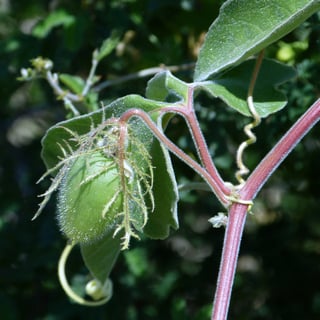
This vine is considered borderline carnivorous. Sticky hairs trap small insects and break them down with enzymes. They are ultimately absorbed into the plant, providing it with nutrients.
How to Prune
Prune your Arizona passionflower back to the ground in late winter or early spring before new growth appears to reinvigorate it and remove any cold damage.
Unlike most landscape vines, it stays a manageable size without much pruning. But you can trim it lightly as needed to control its shape and size.
Plant Lover Facts
Arizona passionflower (Passiflora arizonica) has a small native range. It only occurs in Pima and Santa Cruz counties in southern Arizona and in northern Mexico.
Atypically for a passionflower, it blooms at night. Flowers open in late afternoon and stay open through the night until pollinated, usually by moths. Flowers may remain open the following morning if not pollinated.
Did you enjoy this article?
Sign up for our weekly newsletter
where you’ll find more great info on creating &
maintaining a beautiful, carefree desert landscape.
Author Bio
Deane Alban is the creator of Southwest Gardener. She is a science writer with a bachelor’s degree in botany from the University of South Florida. Gardening is her lifelong passion. She’s been gardening in Tucson for over 15 years.

Photo Credits
Rich Hoyer, CC BY-SA 4.0, iNaturalist.com