
Many desert plants grow in symmetric rosettes and have spiky leaves. Have you ever looked at a plant and wondered, “Is that an agave? Or is it an aloe?” Discover how these two groups of plants are alike, and how they’re different, so that you can reliably tell them apart.
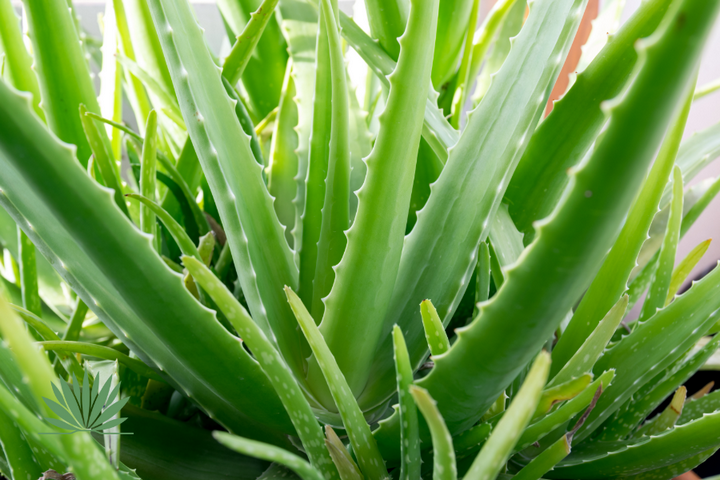
Agaves and aloes are commonly used desert landscape plants that have much in common, so telling them apart can be tricky.
They both have thick leaves that grow in rosettes. Their flowers grow on stalks. When grown as desert landscape plants, they require similar growing conditions (sun to part sun, and low amounts of water).
But I’ve got a few tips that will help you tell them apart most of the time. (Of course, as with most “rules” in life, there are a few exceptions.)
How Agaves & Aloe Differ
For all their similarities, there are also some key differences between agaves and aloes. Here are a few notable ways agaves and aloes differ that will help you tell them apart.
Leaves
Agaves have stiff, tough leaves that usually have serrated edges and/or sharp, pointed tips that can be downright dangerous. If you cut a leaf, you’ll find it to be dry and fibrous.
Agaves are not plants you want to handle with your bare hands. The sharp, black tips of this artichoke agave can easily break skin.
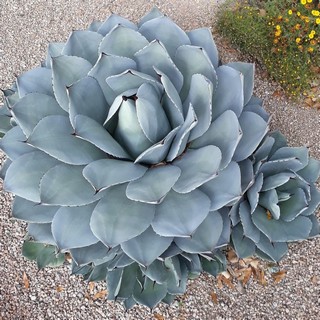
Besides being extremely pokey, handling agaves causes contact dermatitis in many people.
Aloes, on the other hand, are friendlier than aloes and are less likely to do you harm.
Aloe leaves contain a lot of moisture and, compared to agaves, are soft and rubbery. Cut or break an aloe leaf, and it will ooze gel. Aloe’s serrated edges can poke you, but they are fleshy rather than killer-sharp.
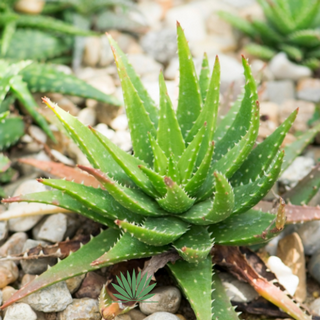
The most popular aloe of all, Aloe vera, is widely regarded for its healing properties. Its gel can be used topically or internally to treat a wide variety of ailments.
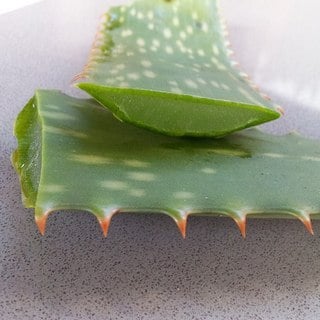
Caution!
Not all aloes are healing – some are poisonous.
Size & Form
Agaves can range greatly in size, but are typically about as tall as they are wide and never have a trunk.
Aloes also can range greatly in size and are usually similar in form to agaves, but some eventually form a tree-like trunk. Cape aloe (Aloe ferox), which becomes nearly tree-like, can reach 10 feet tall!
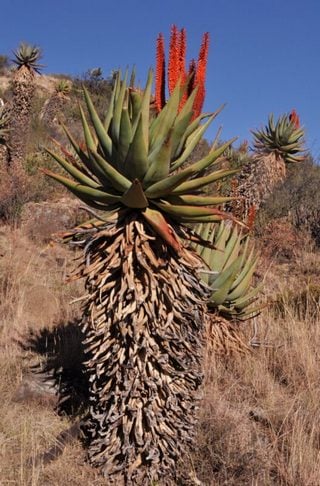
Flowers
Agaves are monocarpic, meaning they bloom once in their lifetime and then die. The appearance of agave flower stalks varies by species, but what they all have in common is that they are big and grow fast.
Agaves only produce one flower stalk that grows directly from the center of the plant.
Agave stalks are huge relative to the size of the plant — some tower at 40 feet! And they grow so fast, up to one foot per day, that you can see the difference from one day to the next.

Stalks look like giant asparagus, apropos for a plant in the Asparagaceae (i.e., asparagus) family. 😉
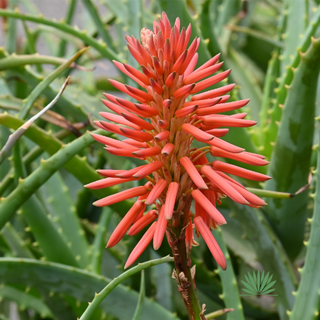
Aloes also send up flower stalks, normally once a year. These stalks are proportionate to the size of the plant.
Unlike agave flower stalks, they are not jaw-droppingly large or fast growing, and do not signal the end of the plant’s life.
Aloes can send up more than one flower stalk at a time. Stalks emerge from between the leaves, not from the center of the plant.
Here’s a typical flower stalk of a typical aloe.
Growing & Planting Season
Agaves do most of their growing in hot weather and are dormant in winter, whereas aloes grow mainly in cool weather — fall through early spring.
Consequently, agaves should be planted in late spring, while aloes should be planted in the fall. Planting with the growing season encourages the development of new roots.
Range
There are currently 225 accepted species of Agave. They only grow naturally in the western hemisphere. Their native range extends from the southern US to northern South America plus the Caribbean. They have naturalized in large swaths on every continent except Antarctica.
There are 592 accepted species of Aloe. They only grow naturally in the eastern hemisphere. Their native range includes most of Africa, the Middle East, and India. Aloes have also naturalized on all inhabited continents.
Agave & Aloe Compared
Here’s a comparison chart that summarizes the differences between these two genera.
| Agave | Aloe | |
| Leaves | Dry, fibrous, sharp | Fleshy, toothed |
| Shape | Approximately as tall as wide | “Usually” as tall as wide* |
| Flowers | Monocarpic, Blooms once | Polycarpic, Blooms annually |
| Flower Stalk | Huge, grows fast | Proportionate, moderate growth |
| Origin | Western hemisphere | Eastern hemisphere |
*As discussed earlier, a few aloes grow tree-like, but they are the exception.
Even with the information presented here, there still might be times when you can’t tell whether a plant is an agave or an aloe.
Other plants can be confused with agaves or aloes, too. Some yuccas look a lot like an agave or one of the tree-like aloes. You can learn to tell the difference between agaves and yuccas here.
Did you enjoy this article?
Sign up for our weekly newsletter
where you’ll find more great info on creating &
maintaining a beautiful, carefree desert landscape.
Author Bio
Deane Alban is the creator of Southwest Gardener. She is a science writer with a bachelor’s degree in botany from the University of South Florida. Gardening is her lifelong passion. She’s been gardening in Tucson for over 15 years.

Photo Credits
The University of Arizona Campus Arboretum
Rae Allen, CC BY 2.0, Wikipedia Commons
Coconino National Forest, CC BY 2.0, Wikipedia Commons