
Many desert plants have spiky leaves and grow in a rosette. Have you ever looked at a plant and wondered, “Is that an agave or a yucca?” Discover how these two groups of plants are alike, and how they’re different.

Agaves and yuccas are commonly used desert landscape plants that have much in common, so it can be hard to tell them apart.
They both have long, spiky leaves that grow in rosettes. When in bloom, their flowers grow on tall stalks. When grown as desert landscape plants, they require similar growing conditions — sunny, hot, and dry.
They are botanical “cousins.” Both Agave and Yucca are plant genera in the Asparagaceae family (formerly Agavaceae family).
But I’ve got a few tips so that you’ll soon be able to tell them apart 99% of the time. (Of course, like most things in life, there are a few exceptions.)
How Agaves & Yucca Differ
For all their similarities, there are also some key differences between these two groups of plants. Here are a few notable ways agaves and yuccas differ that will help you tell them apart.
Leaves
Agaves have leathery, somewhat fleshy, succulent leaves that usually have serrated edges and/or sharp, pointed tips.

Yucca leaves are thinner, straighter, and drier. Yuccas are considered “semi-succulents” rather than succulents. Words that come to mind when describing yucca leaves are “sword-like” or “dagger-like.” They are stiff with pointy tips.
Size
Agaves range from small to huge, but are usually about as tall as they are wide. Yuccas grow taller than wide and some eventually form a tree-like trunk, such as the Joshua tree (Yucca brevifolia). Agaves never have a noticeable trunk.

Flowers
One significant way that agaves and yuccas differ is in their flowers. Both produce flowers that are fascinating in their own right.
Agave Flowers
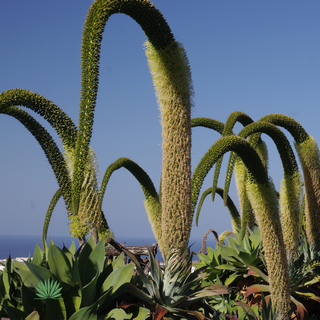
Agaves are monocarpic, meaning they bloom once in their lifetime and then die. There are forms of reproductive stalks — branched and unbranched.
Unbranched flower stalks grow as a pole, such as this foxtail agave’s.
Branched flower stalks grow in a candelabra shape, such as this Weber’s agave’s.
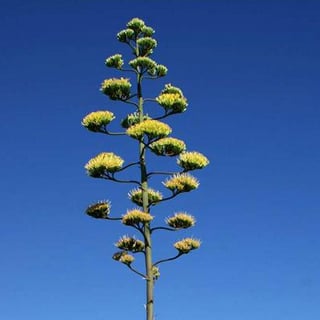
The stalks of some species are covered with flowers that are followed by seeds, while others are covered with baby plants called bulbils.

The appearance of agave flower stalks varies greatly by species, but what they all have in common is that they are big and grow fast. Agave stalks are huge relative to the size of the plant — some tower at 40 feet! And they grow so fast, up to one foot per day, that you can see the difference from one day to the next.
Stalks look like giant asparagus, apropos for a plant in the Asparagaceae (i.e., asparagus) family. 😉
Yucca Flowers
Yuccas are polycaric (bloom more than once) and normally flower every year. All have big, white, bell-shaped flowers that are pollinated by moths. Their flower stalks are tall but are more proportionate to the plant size than agave stalks.

Amazing Fact!
Each species of yucca is pollinated by only one species of moth.
Range
There are currently 225 accepted species of Agave. Their native range extends from the southern US to northern South America, plus the Caribbean. They have naturalized in large swaths on every continent except Antarctica.
There are 54 accepted species of Yucca. They have a more northern natural range than agaves. Their range includes almost every US state and, surprisingly, includes the Canadian provinces of Alberta and Ontario. Yuccas have naturalized on other continents in limited areas.
Agave & Yucca Compared
Here’s a comparison chart that summarizes the differences between these two genera.
| Agave | Yucca | |
| Leaves | Succulent, leathery | Semi-succulent, sword-like |
| Shape | Approximately as tall as wide | Taller than wide, often tree-like |
| Blooms | Monocarpic, Blooms once | Polycarpic, Blooms annually |
| Flower Stalk | Huge, grows fast | Large but proportionate |
| Flower Appearance | Small, color varies | Large, always white |
| # of Species | 299 | 54 |
| Origin | Southern US to South America | Canada to Central America |
There are still a few times that you might be unsure. Don’t feel bad if you can’t always tell them apart. I recently saw a young beaked yucca (Yucca rostrata) that I almost mistook for a twin-flower agave (Agave geminiflora).
But with the information above, you’ll be right most of the time.
There are other plants that can be confused with agaves and yucca, too. Aloes can look a lot like agaves, and some of the large, tree-like aloes can be mistaken for yuccas. Learn how to tell the difference between agaves and aloe here.
Did you enjoy this article?
Sign up for our weekly newsletter
where you’ll find more great info on creating &
maintaining a beautiful, carefree desert landscape.
Author Bio
Deane Alban is the creator of Southwest Gardener. She is a science writer with a bachelor’s degree in botany from the University of South Florida. Gardening is her lifelong passion. She’s been gardening in Tucson for over 15 years.

Photo Credits
California State Parks Foundation
Coconino National Forest, CC BY 2.0, Wikipedia Commons
Port St. Lucie Botanical Gardens
Valerio B. Cosentino, CC BY-SA 4.0, via Wikimedia Commons